At the end of 2025, 413 commercial reactors were online worldwide, delivering 377.1 GW(e) across 31 countries (IAEA, 2026). What changed since 2024 is not the fleet size — it is who is signing the offtake: Microsoft, Amazon, Meta and Google have papered multi-decade PPAs tied to reactor restarts and to planned small modular reactor (SMR) campuses. The balance-of-plant (BOP) electrical bus inside those projects is ordered on a shorter clock than the reactor pressure vessel, and that is exactly where laminated copper work meets the nuclear industry — with a hard 1E vs non-1E line in between.
At the end of 2025, 413 commercial reactors were online worldwide, delivering 377.1 GW(e) across 31 countries (IAEA, 2026). What changed since 2024 is not the fleet size — it is who is signing the offtake: Microsoft, Amazon, Meta and Google have papered multi-decade PPAs tied to reactor restarts and to planned small modular reactor (SMR) campuses. The balance-of-plant (BOP) electrical bus inside those projects is ordered on a shorter clock than the reactor pressure vessel, and that is exactly where laminated copper work meets the nuclear industry — with a hard 1E vs non-1E line in between.
This page is an annual rolling data page: the 2026 edition, refreshed once a year as new market data is published.
The reference deal is the 20-year power purchase agreement Microsoft signed with Constellation Energy in September 2024 to restart Three Mile Island Unit 1, now renamed the Crane Clean Energy Center. Constellation frames the deal as roughly 835 MW of carbon-free capacity, with a target commercial restart in 2027–2028 and a required refurbishment of the turbine, generator, main transformer and supporting balance-of-plant systems (Constellation, 2024). Constellation itself notes the restart is on schedule as of its one-year update in September 2025.
Amazon's route is different. In October 2024 Amazon committed up to $500 million in X-energy and anchored a first 320 MW phase — four Xe-100 modules — with Energy Northwest in Washington State, with an option to grow to 960 MW and a company-wide target of more than 5 GW of new U.S. nuclear by 2039 (Amazon, 2024). In October 2026 Amazon and X-energy added a nearly 1 GW Indiana project with AEP. Meta, meanwhile, is paired with Oklo on a planned up-to-1.2 GW Aurora powerhouse campus in Pike County, Ohio (Oklo, 2025). These are not grid-tied merchant deals; they are dedicated, long-tenor electrons aimed at AI load.
For a laminated busbar shop, the order signal is not the reactor pressure vessel — that is a 60–80 month forged-and-welded forgings story. The signal is the BOP switchgear, the turbine island auxiliaries, the 480 V motor control centers (MCCs) and the station-service transformers that have to be ordered on a much shorter schedule to support the first concrete and first fuel dates announced in those PPA press releases.
Utility-scale PPAs like Crane are not physically behind the meter: electrons enter PJM, and the data center buys attributes. A true behind-the-meter (BTM) interconnection puts the plant switchyard on the same site as the data center load, sometimes on the same substation bus. In a BTM SMR campus, the reactor auxiliary power and the data center medium-gear share a physical fence, a ground grid and a set of site cables — even when their metering and protection boundaries are kept clean.
That sharing changes the busbar specification on both sides. The reactor side expects Class 1E and non-1E separation, single-point ground references, seismic qualification and environmental aging envelopes. The data center side, even when it buys into our 800 VDC power architecture, expects fast short-circuit delivery, high inrush tolerance from UPS and battery racks, and a completely different maintenance culture. The interface switchgear between the two is where a lot of the custom laminated busbar work lands.
Readers who want the other end of the interface can look at how the data center side is reshaping medium-voltage gear in our companion piece on U.S. switchgear busbar trends — the two conversations are converging on the same factory floor, but under very different qualification regimes.
Class 1E (the designation is a safety classification, not a voltage) is the NRC designation for electrical equipment and systems that are needed to safely shut down the reactor, remove residual heat, or contain radioactivity. Everything else — turbine-driven feedwater pumps on non-safety power, ventilation, cooling towers, cranes, lighting, the data center feed itself — is non-1E.
For a laminated busbar supplier, this distinction decides which document pack you need to ship with. Non-1E BOP busbar, installed inside the turbine island, in the 480 V switchgear lineup, in the auxiliary MCCs, or feeding the data center interface gear, is essentially industrial LV switchgear hardware built to IEC 61439 / ANSI C37 style duty cycles. We cover the IEC side in our IEC 61439 reference. You need copper-to-copper contact resistance data, short-time withstand ratings, temperature rise limits and a clean layer-to-layer partial-discharge record — but you do not need a 40-year qualification file.
Class 1E busbar is a different animal. It cannot be off-the-shelf industrial product relabeled. It requires an environment and seismic qualification package, independence from redundant divisions, and a documented qualified life that matches the plant design life (typically 60 years for new builds). The hint for procurement teams: if a supplier cannot produce a qualification test report traceable to a specific IEEE standard, the part does not belong in a 1E division, no matter how good the copper looks.
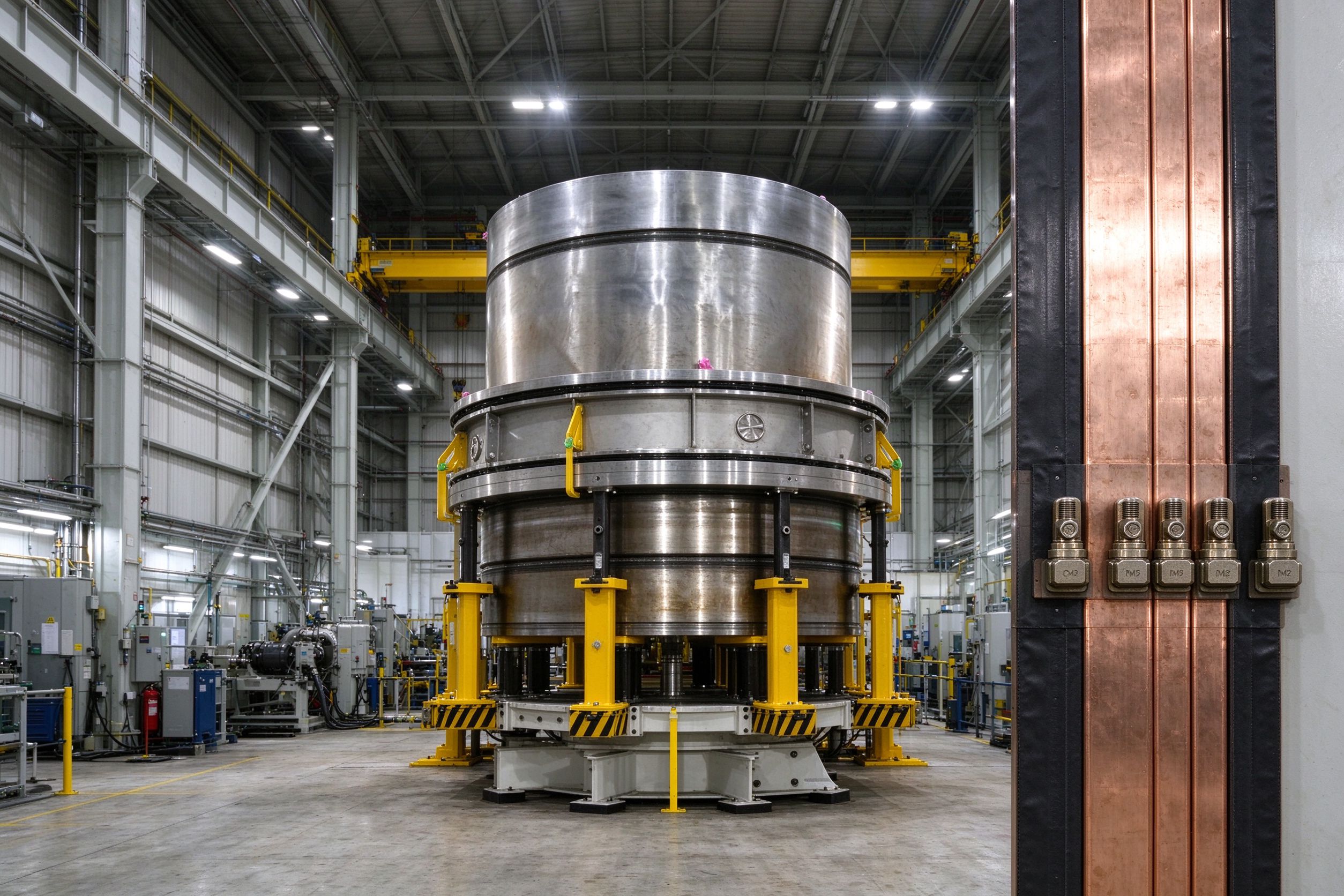
IEEE Std 384, Standard Criteria for Independence of Class 1E Equipment and Circuits (the 2008 revision is the current line; a new PAR P384 is active), defines how redundant 1E divisions must be physically separated from each other and from non-1E circuits. NRC Regulatory Guide 1.75, Criteria for Independence of Electric Systems, endorses IEEE 384 and spells out the concrete separation distances, barrier requirements and associated-circuit rules that U.S. applicants license against.
The practical effect on busbar layout is non-trivial. Two divisions of 480 V safety switchgear cannot sit back-to-back in the same room without a fire-rated barrier, and a non-1E tray routed alongside a 1E division needs either a minimum free-air separation (RG 1.75 gives an inch-class clearance between a 1E tray and a totally enclosed non-1E raceway, with larger open-air gaps) or a grounded metallic barrier. A laminated busbar assembly that bridges across divisions — say, a common ground bar — has to be analyzed as an associated circuit, because a single fault on the non-1E side must not propagate into a 1E train.
This is why we push back when a BOP integrator asks for a single multi-layer laminate that carries both a 1E feed and a non-1E customer feed on the same copper stack. The insulation system between layers is excellent for PD and dielectric, but it is not the barrier RG 1.75 asks for. The right answer is two separate laminates, mounted on independent standoffs, with a documented separation distance. Our creepage and clearance guidance covers the industrial side; for nuclear 1E work, the separation geometry is decided by the plant UFSAR, not by the datasheet.
IEEE Std 323, Qualifying Class 1E Equipment for Nuclear Power Generating Stations, sets the envelope: equipment must demonstrate it can operate through its required service life under the combined effects of normal aging, the design-basis event (loss-of-coolant accident, spray, steam, radiation) and a safe-shutdown earthquake. IEEE Std 344, Seismic Qualification of Class 1E Equipment, spells out the shake-table and analysis routes, including aged-equipment first (thermal and radiation aging before seismic testing) followed by shake at the required SSE g-level.
A laminated busbar is a passive component, which helps: passive parts have to maintain structural and pressure-boundary integrity rather than operate continuously. But 'passive' does not mean 'free.' The dielectric film, the epoxy edge seal, the potting compound and the bolted studs all age under temperature, humidity and radiation. A PET/Nomex stack rated for 130 °C continuous in an industrial MCC may not survive a 60-year qualified-life envelope in a 1E switchgear room without accelerated aging data.
For non-1E BOP work, you can lean on standard industrial aging evidence — thermal cycling, humidity exposure, salt fog — plus a factory type test. For 1E work, the laminate, the fasteners and the insulating supports need a qualification file traceable to a specific plant UFSAR. Procurement teams new to nuclear often ask whether our standard laminated range can be quoted for 1E. The honest answer is: not without a qualification program, and we do not claim one.
The turbine island is industrial. The 6.9 kV / 4.16 kV unit auxiliary transformer steps down to 480 V (690 V in many European and Korean designs) for the boiler feed pump motors, circulating water pumps, condensate pumps, lift pumps, HVAC and the row of motor control centers. This switchgear lineup is built to IEC 61439 or ANSI C37.20.1, and the internal copper — between main bus, section bus, feeder devices and neutral bars — is exactly the kind of rigid or laminated copper work that a B2B busbar shop like ours already ships to drive and ESS customers.
Typical ratings in this lineup: main bus 3,200–6,300 A at 480 V, short-time withstand 50–100 kA for 1 s, temperature rise limit 65 K over a 40 °C ambient. The copper is C11000 (ETP), tin-plated at the studs, insulated with PET or Nomex, held by glass-filled polyester or SMC standoffs. We size these in our ampacity reference and validate the joint temperature rise in the temperature-rise test guide.
Two nuclear-specific wrinkles show up here. First, the switchgear lineup in the turbine hall is often classified 'non-safety related but required for startup,' which means the plant has to demonstrate that a busbar fault will not degrade a 1E train — so separation, cable routing and fault current contribution from the 1E emergency diesel generator have to be coordinated. Second, the equipment has to survive the site seismic response spectrum even when it is non-1E, because a collapsed busbar in the turbine island can still trip the unit. Expect seismic analysis or shake-table evidence even on non-1E MCCs in a U.S. NRC-licensed plant.
Every operating reactor has a 125 V DC station (some older units 250 V) backed by flooded-cell or VRLA batteries and charged by redundant rectifiers. That DC bus trips the reactor trip breakers, closes the ESF actuations, drives the emergency valve solenoids and powers the instrument buses during a station blackout. It is unambiguously 1E, divided into redundant divisions (typically A, B, and sometimes C) that must stay independent.
The busbar inside a 125 V switchgear cabinet is not exotic — rectangular copper, silver or tin plated, bolted to the cell breakers — but it is qualified. Insulation resistance to ground has to stay above a threshold during battery discharge, creepage distances have to account for conductive dust in the battery room, and the laminate (when used to reduce inductance on the trip coil feed) has to survive the same IEEE 323 / 344 envelope as the rest of the division. Our DC insulation design notes in the 800 VDC busbar insulation guide are written for data center and ESS use; the physics of creepage and tracking are the same, but the qualified-life evidence required by the NRC is not.
For SMR designs that use DC-rated DC fast charge converters for the data center load — the emerging 800 VDC / ±400 VDC architecture — the DC bus voltage class jumps well above the 125 V safety station. That is a different insulation coordination problem, covered in section 11 below. The 125 V safety bus and the ±400 VDC data center bus should never share a laminate, a cabinet or a ground bus without a documented interface analysis.
When a laminated busbar is seismically qualified, three things are pushed simultaneously: copper yield under SSE g-loading, bolted stud preload loss after shake, and dielectric margin after aging. The copper itself is rarely the limiting element; C11000 has ample yield strength. The failures that show up in seismic reports are in the insulating standoffs, in the potting compound at the edges, and in the bolted joints where slip under shaking can relax torque.
Engineers on our end typically specify:
For non-1E BOP laminates, the seismic envelope is usually the plant URS, not the SSE spectrum — typically 0.1–0.2 g floor response at the equipment level — and the aging envelope is the normal plant maintenance life, not 60 years. That is the work a B2B laminate supplier can actually quote without a nuclear qualification program.
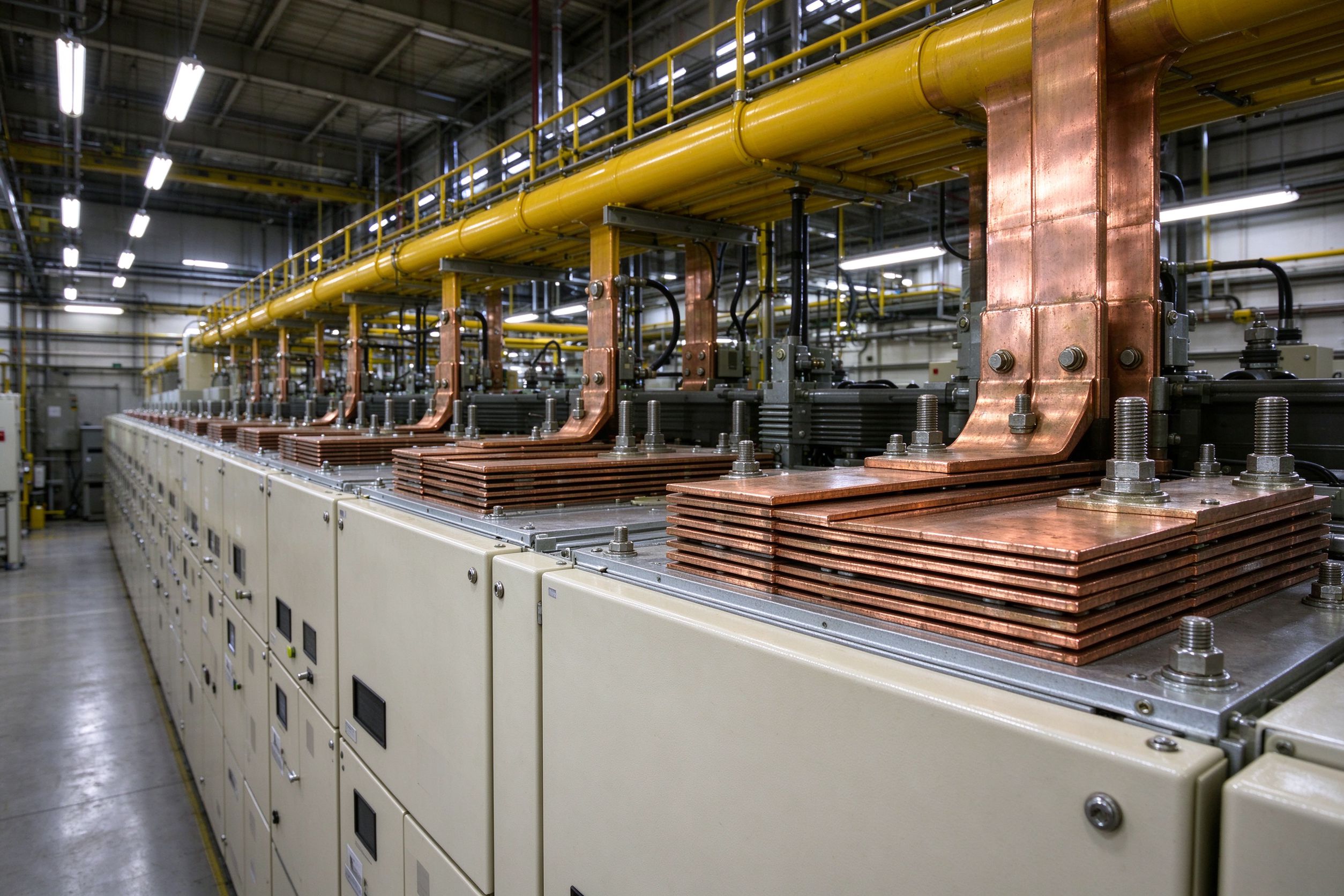
A laminated busbar is a built-in partial-discharge risk because it sandwiches a dielectric between two copper planes. In a clean data center cabinet, 1,000–2,000 pC discharge levels are acceptable and we document them in our PD reference. In a nuclear switchgear room — where ambient humidity, conductive dust from the turbine hall and long maintenance outages all stress the surface — the PD baseline has to be tighter, and the insulation coordination has to survive a 40–60 year service life.
The practical knobs are film choice, edge clearance and tracking index. PET (130 °C) is the workhorse for non-1E BOP. Nomex or DLF constructions are specified where elevated temperature or tracking is a concern. Creepage distance along the edge between layers is set by the working voltage and the pollution class; for 480 V systems in a clean turbine hall that is a short track, but for the 4.16 kV unit auxiliary bus feeding the 690 V secondary, creepage jumps by an order of magnitude. We walk through the selection logic in the dielectric selection guide.
The arc-flash side matters too. A busbar in a nuclear MCC has to survive the internal arc classification the plant specifies; our companion article on internal arc containment for switchgear busbar covers the IAC ratings, pressure relief and flange seal details that integrators should be asking for.
The reactor pressure vessel, the steam generator, the main turbine and the generator are 60–90 month long-lead items. A factory-fabricated SMR module — think a Xe-100 or Nuward-style skid — is shorter, but the forged pressure vessel and the nuclear-grade coolant pumps still dominate the critical path. A laminated busbar, by contrast, is a 10–20 week fabricated item once drawings and copper stock are released.
That asymmetry creates a procurement trap. A BOP integrator that waits until the nuclear island long-leads are frozen to release the 480 V switchgear busbar RFQ will find itself competing for the same copper processing slots as every other data center, ESS and wind-converter project on the planet — and paying spot copper plus a surcharge. The right sequencing is to release the non-1E busbar specification at the same time as the site civil works, because the copper stock and the film stock are not on the reactor critical path but they are on the electrical installation critical path.
We cover the make-vs-buy and sourcing logic in the laminated busbar make-vs-buy guide, and the lead-time and MOQ mechanics in the MOQ and lead-time TCO guide. For an SMR program, the takeaway is simple: the non-1E busbar order is not urgent next week, but it has to be released this quarter, because copper processing slots in 2027 are already being booked by AI data center buildouts.
The data center side is moving fast toward 800 VDC bipolar distribution (±400 VDC, with a solidly grounded center tap in many architectures). The nuclear station side is still AC: 480 V / 690 V LV switchgear, 4.16 kV / 6.9 kV unit aux, 125 V DC safety. The two architectures share a fence on a BTM campus but they do not share a busbar design.
The differences are not subtle:
| Attribute | Nuclear BOP (480/690 V AC) | Data center (±400 VDC / 800 VDC) |
|---|---|---|
| Voltage class | 480 V / 690 V AC, 50/60 Hz | ±400 VDC, bipolar |
| Fault current | 50–100 kA, symmetrical AC | DC fault limited by converter; fast current rise |
| Insulation coordination | Phase-to-phase creepage, pollution class | Unearthed/IT ground, transient overvoltage, clearance to ground |
| Qualified life | 40–60 years, IEEE 323/344 if 1E | 10–15 years, industrial standards |
| Maintenance culture | Refueling outages, 10-year ISI | N+1 hot-swap, yearly IR scans |
The DC side's PD behavior is also different. DC does not cross zero, so partial discharge extinction is harder; creepage paths track differently; and the solidly grounded center tap changes touch-voltage calculations. Our notes on 800 VDC busbar insulation go deeper. The interface gear between a nuclear BTM bus and an 800 VDC data center bus — typically a medium-voltage breaker, a transformer and an AC/DC conversion skid — is where custom laminate work is most likely to be specified, and where the two insulation regimes have to be reconciled by the EPC, not by the busbar vendor.
Based on the work we quote for switchgear, ESS and industrial drive customers, here is the short RFQ list that separates a real nuclear-BOP busbar supplier from an industrial shop that cannot answer the questions:
We are happy to walk through this list on a project inquiry. What we will not do is quote a part as '1E qualified' without a qualification program — that line belongs in a UFSAR, not in a sales email. If you need a quote for non-1E BOP laminates, start from our custom copper busbar page and share the single-line diagram.
The same BOP electrical discipline is showing up on two adjacent frontiers. Fusion pilot plants need pulsed-power busbars that carry 100 kA-class discharge currents into magnets — a totally different duty from steady-state 480 V switchgear, but the same questions about laminated inductance, joint temperature rise and seismic mounting. We cover that in the fusion-pilot piece on pulsed-power busbar for fusion pilots.
Industrial heat electrification — electric boilers, electrode heaters, resistance process heat — pulls tens of MW of three-phase load through LV switchgear and transformer secondaries, and the busbar inside those E-house substations is built on the same BOP playbook. Read more in the industrial heat electrification piece.
The common thread: nuclear BOP, fusion pulsed power and industrial heat electrification all ask the busbar supplier for the same engineering discipline — real copper traceability, documented PD, seismic or vibration evidence, and an honest line between what is off-the-shelf and what needs a qualification program. If your next SMR or reactor-restart PPA just closed and you are starting to scope the BOP switchgear, the time to release the non-1E busbar drawings is now, not after the vessel order.
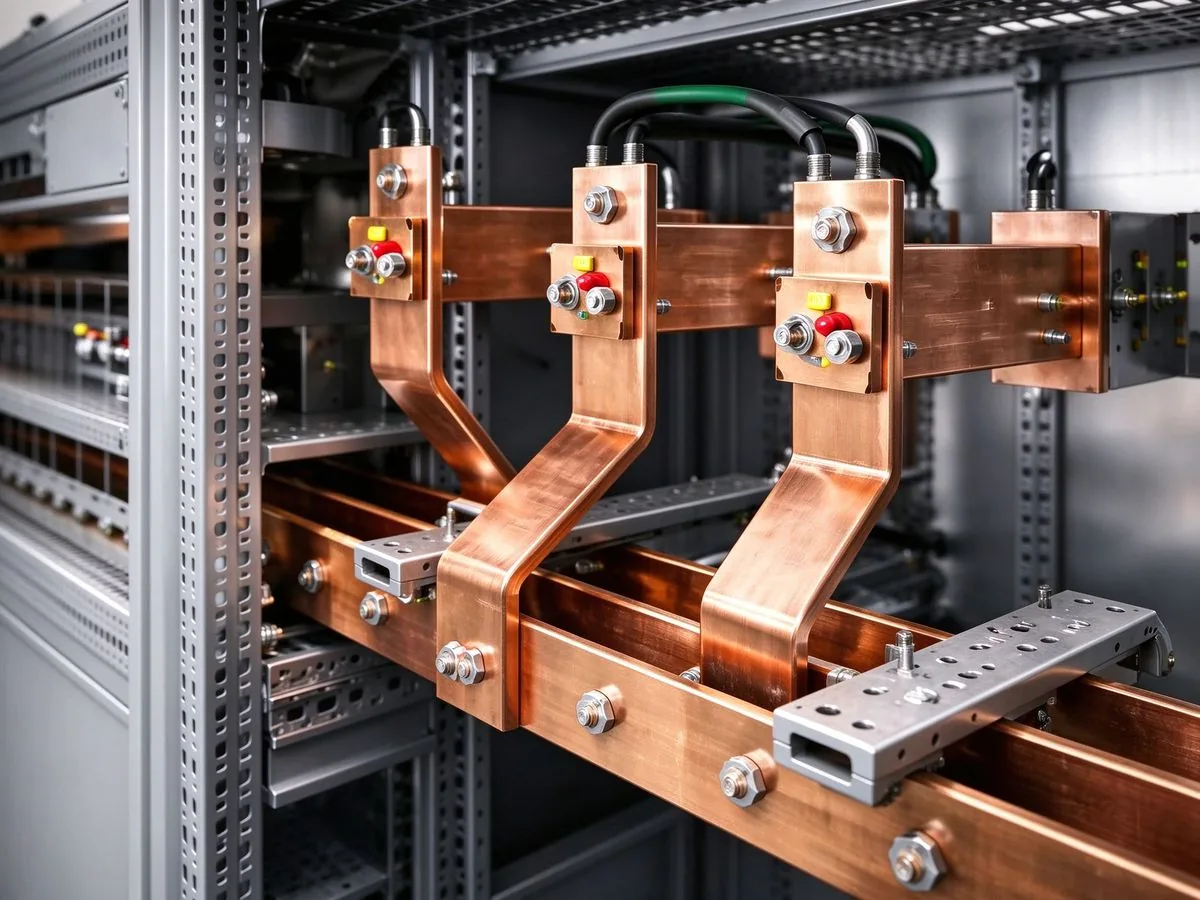
800 VDC moves the conversion stage to the cluster and pushes a higher-voltage DC bus into
Read article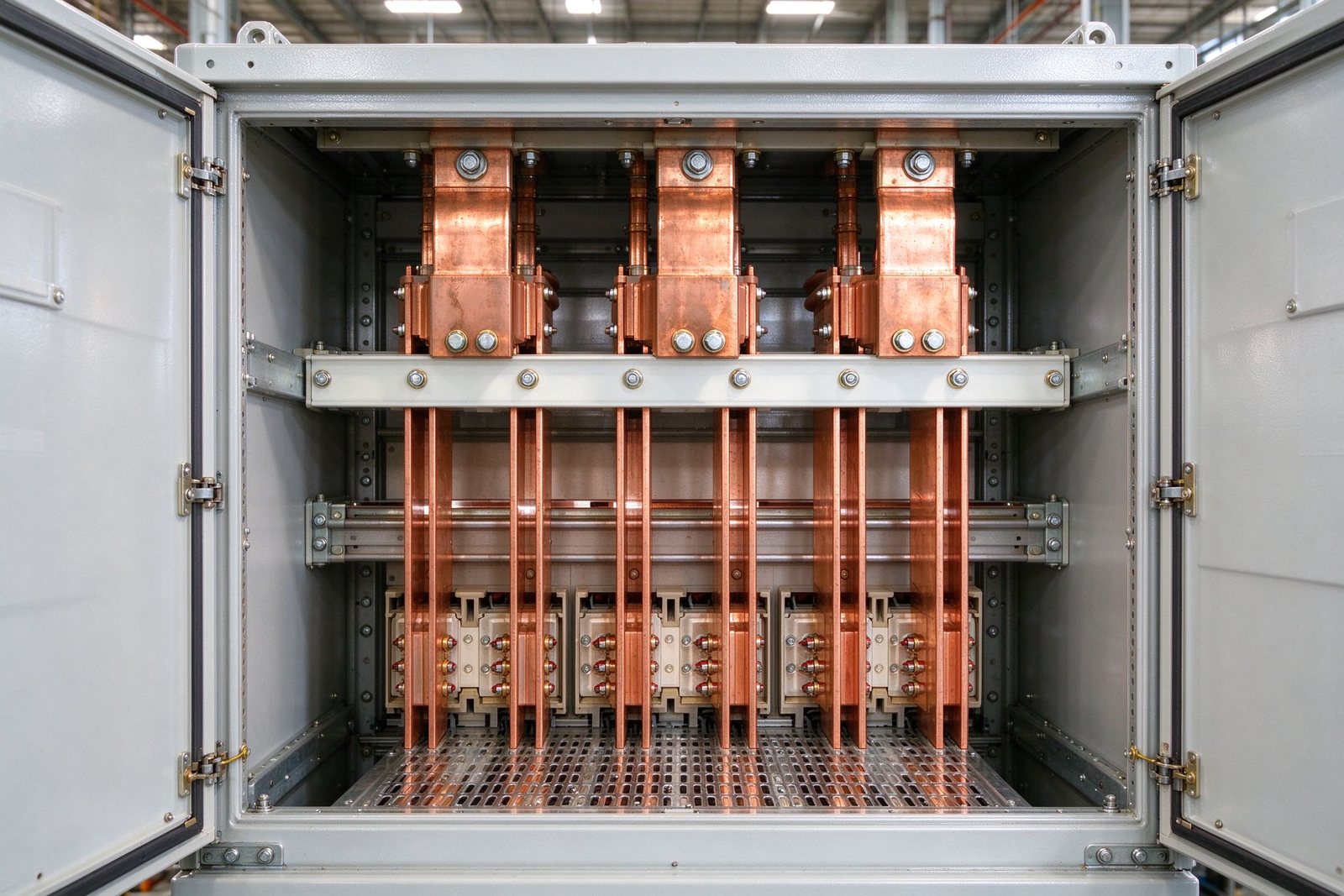
US switchboards are certified differently from IEC assemblies: the SCCR belongs to the ass
Read article
Aiko Tanaka is application engineering manager at SHANYUAN, with 11 years in applying laminated busbars to data centres, energy storage and new-energy systems. She leads application selection, custom-profile development and project delivery, and holds a B.Eng. in Electrical Engineering from the Univ
Send the current profile, voltage class and terminal types — our engineers reply within one business day.