Grid-scale storage in North America just had its best quarter on record. ERCOT reached 18.7 GW / 33.4 GWh of commercially operational battery storage by 30 September 2026, adding 2.2 GW in Q3 alone — the most in any single quarter ever recorded by Modo Energy. The same momentum shows up globally: SNE Research counted 779.9 GWh of lithium-ion battery shipments for stationary storage in the first three quarters of 2026, up 73% from the 451.5 GWh shipped a year earlier. For every one of those megawatt-hours, a laminated busbar carries the DC current between cells, racks and power conversion systems. This article looks at what the record quarter changes for busbar engineering, procurement and lead times.
Grid-scale storage in North America just had its best quarter on record. ERCOT reached 18.7 GW / 33.4 GWh of commercially operational battery storage by 30 September 2026, adding 2.2 GW in Q3 alone — the most in any single quarter ever recorded by Modo Energy. The same momentum shows up globally: SNE Research counted 779.9 GWh of lithium-ion battery shipments for stationary storage in the first three quarters of 2026, up 73% from the 451.5 GWh shipped a year earlier. For every one of those megawatt-hours, a laminated busbar carries the DC current between cells, racks and power conversion systems. This article looks at what the record quarter changes for busbar engineering, procurement and lead times.
This page is an annual rolling data page: the 2026 edition, refreshed once a year as new market data is published.
Three data points frame the current market. First, ERCOT: 20 battery units across 18 sites reached commercial operation in Q3 2026, adding 2.2 GW and 4.6 GWh — beating the previous quarterly record of 2.05 GW set a year earlier, according to Modo Energy (October 2026). Second, SNE Research reported on 5 November 2026 that global ESS lithium-ion battery shipments reached 779.9 GWh in January–September 2026, up 73% year-on-year. Third, CNESA data shows China's new energy storage additions hit 35.30 GW / 102.31 GWh in the first nine months of 2026, with grid-side independent storage accounting for roughly 95% of September's 4.33 GW / 14.08 GWh. The common thread: grid-scale, multi-hour systems are where the growth is, and every one of them needs a low-inductance, high-current DC path from cell to inverter.
Revenue stacking — energy arbitrage, ancillary services and capacity — rewards duration. Modo Energy's ERCOT BESS index put annualized revenue for the average battery at roughly $24/kW-year through mid-August 2026, a level that pushes operators toward 2-hour-plus configurations and, increasingly, 4-hour dispatch. Longer duration at the same power rating means deeper cycling and higher sustained DC current, which is exactly where a well-sized busbar thermal-management budget matters. A system that discharges for four hours cannot hide a hot joint behind a short burst; the steady-state temperature rise of every bolted interface has to stay inside the design window, which is why SHANYUAN quotes against a controlled 30 °C temperature-rise criterion rather than a peak-current number.
A typical 5 MWh container has dozens of battery racks, a DC bus that pools them, and one or more PCS units. The DC-link laminated busbar sits at two levels: rack level, where multi-terminal battery module busbars tie cells and modules together, and copper battery link busbar pairs connect rack outputs to the pool bus; and system level, where power-electronics busbars carry the combined current into the PCS DC input. Because the pool bus carries the full container current — often 1,000 A to 2,000 A at 1500 V DC — its cross-section, plating and bolted-joint design dominate system resistance and loss. Getting the loop geometry right at this level is also the cheapest way to keep switching-loop inductance low for the PCS semiconductors.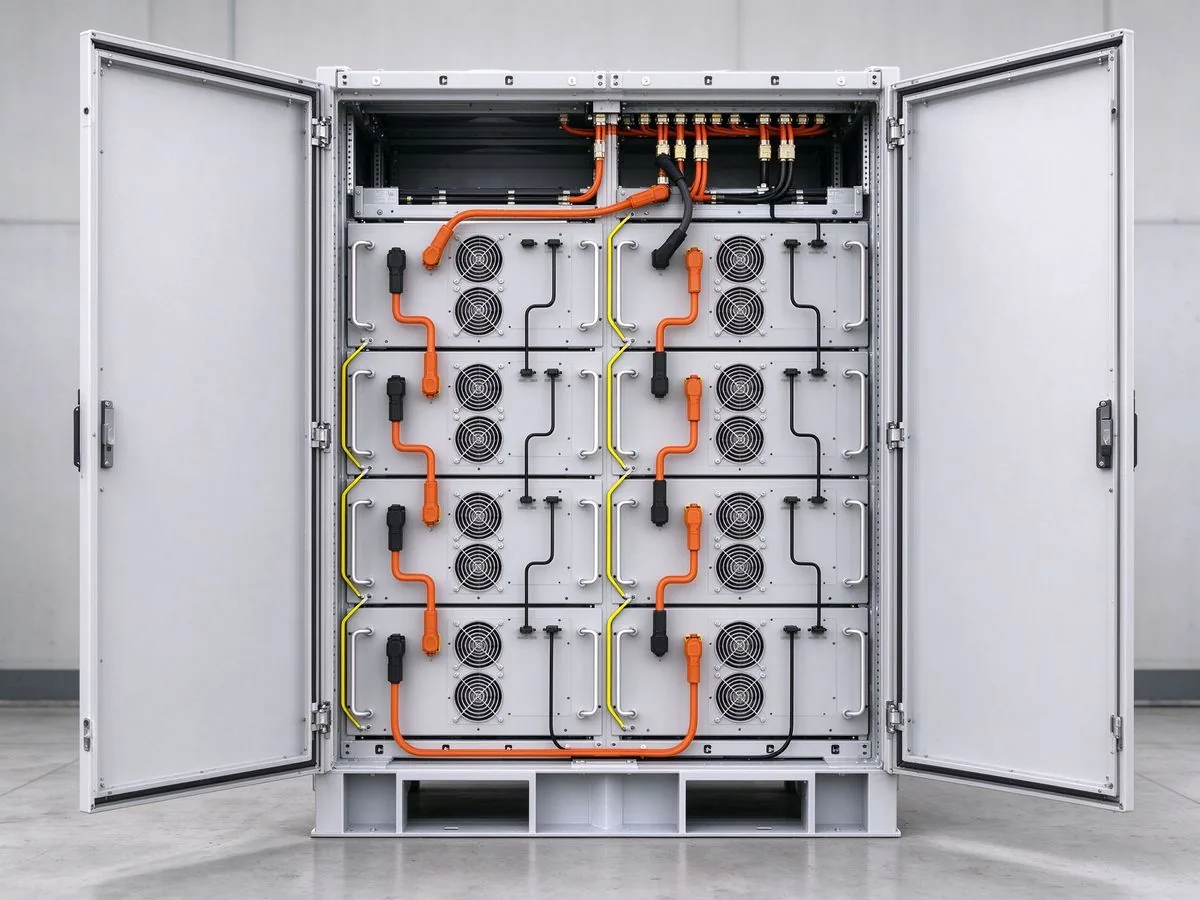
Nearly every new North American grid project is built on a 1500 V DC string, and the industry is already discussing 2000 V DC next. At 1500 V DC, a laminated busbar must hold the working voltage between adjacent copper layers and against ground with real margin. That means partial-discharge-free design above the operating voltage, adequate clearance and creepage, and a dielectric stack — PET, Nomex or DLF — chosen for the actual voltage class, not a generic rating. The practical rule at SHANYUAN: for 1500 V strings we validate the insulation design against the working voltage plus a safety margin, and we verify with PD testing on representative samples before mass lamination, not after. A 100 kV test on a thin film tells you little about a 1500 V DC service condition if the edge sealing and bend radii are wrong.
At 1,500 A continuous, a busbar's DC resistance stops being a rounding error. Ten milliohms at the pool bus wastes 22.5 W per 1,000 A²·m — and in a sealed container that heat has nowhere to go but into the enclosure. Two levers matter most: copper cross-section (thicker and wider bars, multiple layers when the current is extreme) and contact quality at every bolted joint, where conductor material and plating determine long-term resistance drift. Tin-plated C11000 copper with controlled bolt torque and Belleville washers is the workhorse for grid storage because it balances conductivity, cost and field serviceability. Nickel and silver are reserved for the joints where oxidation resistance or lower contact resistance buys more than the premium costs.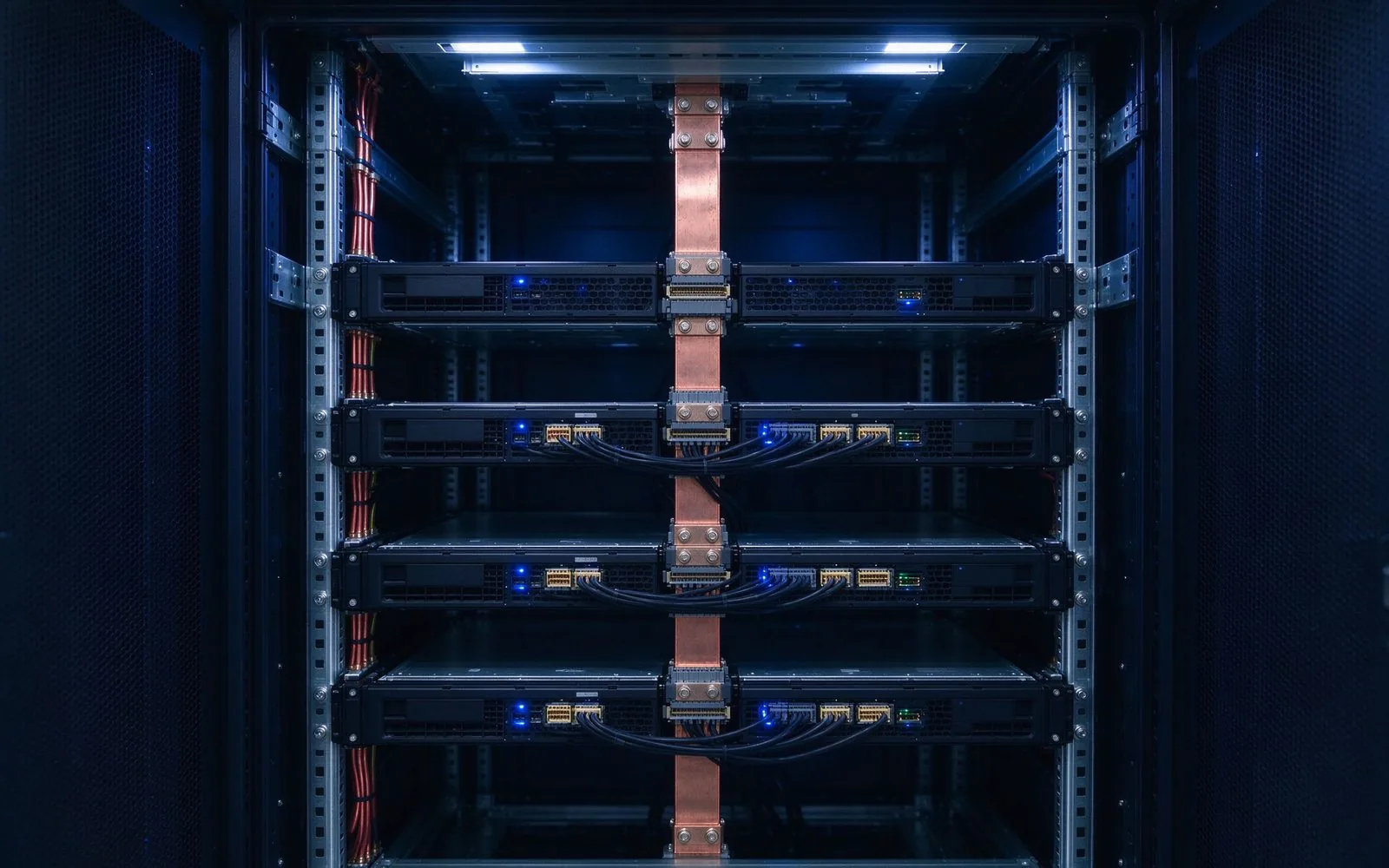
When racks share a common DC bus, the physical layout decides how evenly current splits. Unequal path lengths between rack output and the PCS input create unequal impedance, which shows up as uneven current sharing, hotter cells in one rack and faster aging. A laminated busbar addresses this with symmetric geometry: mirrored current paths, interleaved layers so positive and negative rails cancel magnetic fields, and balanced bolt patterns. This is a design conversation, not a catalog lookup — which is why our custom design service starts with the mechanical envelope and connection points, then optimizes the laminate stack for sharing and inductance, and returns a DFM review within one business day.
The 314 Ah cell is now standard and 500 Ah-plus cells are ramping in China and Korea, pulling rack current up with them. A 500 Ah cell string at 1P means 500 A per cell busbar segment; at 2P the connector system has to handle 1,000 A with the same 30 °C budget. Larger cells also mean fewer, heavier connections — and each one must survive battery-busbar thermal cycling, vibration during transport and field handling. SHANYUAN's answer for high-amp cell interconnects is a compact, edge-sealed laminate with welded or ultrasonically bonded tabs where the cell maker specifies them, and plated stud or blade terminals where module assembly is automated. The trend is toward fewer, larger, better-verified connections rather than more small ones.
Grid storage is serviced in the field, often by crews that did not install the system. That shifts engineering choices: plated studs with torque-marked nuts beat fragile push-ons; blade terminals speed rack swap-out; welded joints are reserved for locations that never need to come apart. Every bolted interface needs a documented torque spec and a way to verify it after vibration. Our busbar components and accessories range exists precisely because field maintenance eats systems with unserviceable connections. And because a container is a confined space, the busbar layout must leave tool access to every joint — a requirement that belongs in the DFM checklist, not discovered during commissioning.
UL 9540 certification and NFPA 855 installation rules frame what a busbar can and cannot do in a North American installation. The busbar itself is usually a component inside a listed system, but its insulation class, flammability and arc-withstand behavior feed the system evaluation. Insulating films and edge seals must be rated for the working voltage and not propagate flame; busbar layouts must keep clearance around live parts for the service environment; and PD-free operation matters most in the 1500 V class where partial discharge at altitude or in humidity can shorten insulation life. These are exactly the properties SHANYUAN verifies in quality and testing — hipot, PD and thermal cycling on production samples — so the integrator gets components that behave inside the certified envelope.
A record quarter compresses schedules everywhere. Integrators ordering busbars in October want prototypes in November and production in December, which collides with copper lead times, film availability and lamination capacity. Two procurement habits keep projects on schedule: freezing the mechanical envelope early (cell footprint, rack layout, terminal positions) and ordering DFM review before the POs are cut, so that edge seals, hole patterns and plating are fixed once. This is the difference between a busbar manufacturer that ships from stock patterns and one that engineers each laminate — the second is slower on day one and faster on the critical path. Ask any candidate supplier for their current lamination capacity and lead time on 1500 V DC-link assemblies; the answers separate the production lines from the job shops.
Busbar RFQs from storage integrators improve fastest when they include five things: (1) the mechanical envelope and mounting holes; (2) the electrical duty — nominal and peak DC current, working voltage, and the temperature-rise budget; (3) terminal type and positions with mating hardware; (4) environmental conditions — indoor container, humidity, altitude; and (5) the test and documentation expectations — PPAP, PD reports, material certificates. With that package a supplier can quote copper mass, film stack and lead time in one round instead of three. SHANYUAN publishes its busbar ampacity chart and derating guidance so the electrical baseline is agreed before drawings exist, and we answer technical RFQs within one business day.
Three trends will shape the next cycle. First, 2000 V DC strings are on every integrator's roadmap to cut copper mass and cable cost — which raises the insulation and PD bar for laminated busbars again. Second, long-duration storage (6–8 hour and beyond, from lithium to iron-air and flow chemistries) favors lower C-rates and steadier current, shifting thermal design from peak management to sustained-loss management. Third, copper supply pressure — Chile's 2026 output forecast was cut to 4.94 million tonnes by Cochilco — keeps pushing designers to shave copper mass through better geometry rather than thicker bars — the copper grade and temper decisions that follow matter as much as the geometry. Each of these plays into the same engineering: laminated busbar design that is verified, documented and delivered on schedule. The record quarter is not a spike; it is the new baseline.
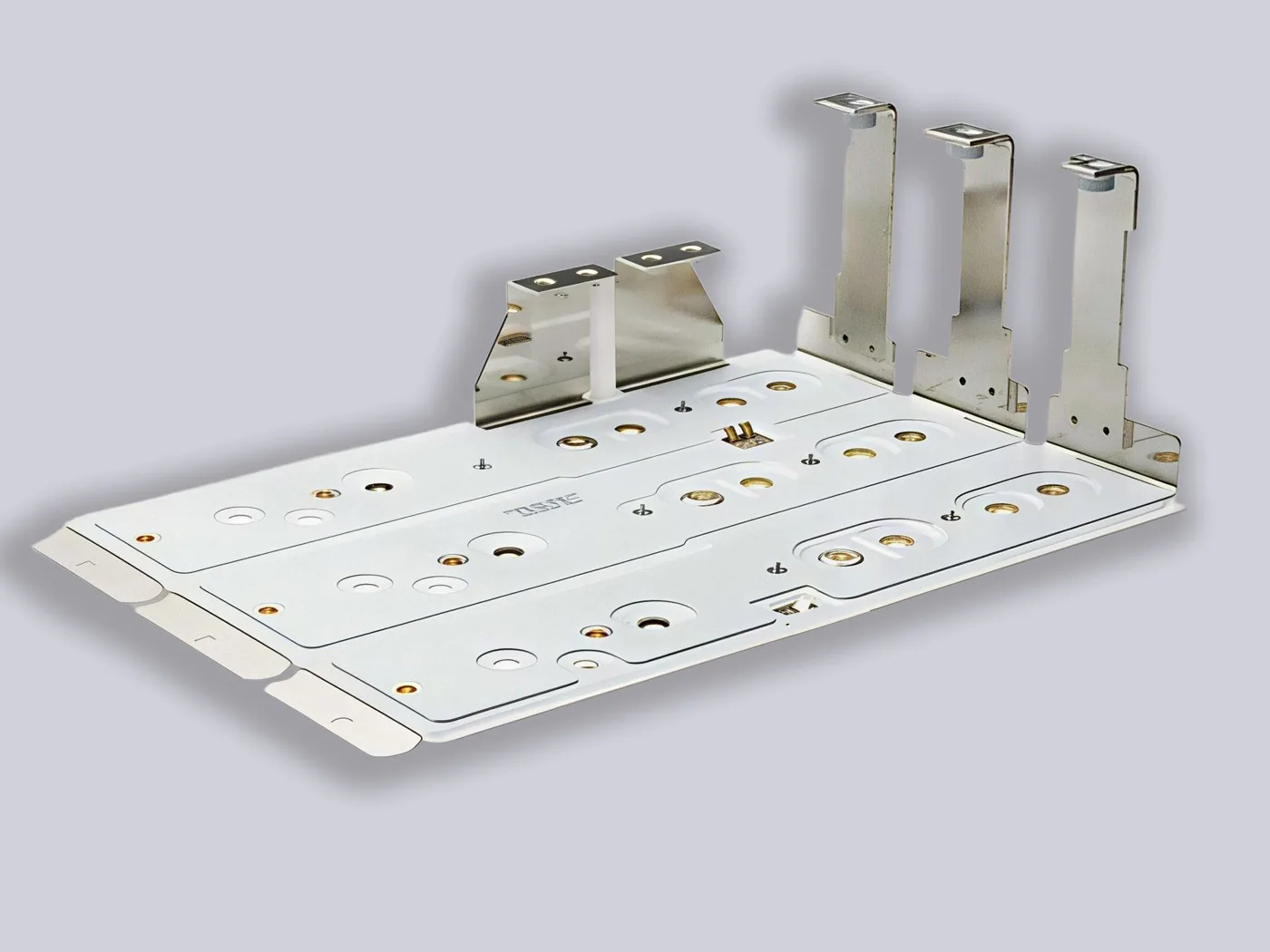
The 500 Ah cell changes everything downstream: higher current per busbar segment, fewer bu
Read articleGlobal energy storage additions are forecast at 158 GW in 2026, up 45% year-on-year, with
Read article
Emily Novak analyses energy-storage, grid and new-energy markets and turns them into procurement-ready technical content. With 7 years in energy market research and technical writing, she covers BESS growth, HVDC projects and regulatory shifts that change busbar demand. She holds an M.A. in Energy E
Send the current profile, voltage class and terminal types — our engineers reply within one business day.