Energy storage crossed the 100 GW mark in 2025 and kept accelerating: BloombergNEF forecasts 158 GW of global annual additions in 2026 — a 45% surge — and 308 GW by 2036. China alone passed 168 GW of cumulative new-type storage by June 2026. Every gigawatt of that build-out passes through a power conversion system (PCS), and every PCS contains a DC-link busbar that has to carry more current at higher voltage in a smaller cabinet. This article reads the 2026 storage market through the lens of that component.
Energy storage crossed the 100 GW mark in 2025 and kept accelerating: BloombergNEF forecasts 158 GW of global annual additions in 2026 — a 45% surge — and 308 GW by 2036. China alone passed 168 GW of cumulative new-type storage by June 2026. Every gigawatt of that build-out passes through a power conversion system (PCS), and every PCS contains a DC-link busbar that has to carry more current at higher voltage in a smaller cabinet. This article reads the 2026 storage market through the lens of that component.
BloombergNEF's May 2026 outlook put 2025 global storage additions (excluding pumped hydro) at 112 GW — the year storage entered the '100-gigawatt era' — and forecasts 158 GW for 2026 and 308 GW for 2036. The October 2026 BloombergNEF update frames 2026 as a 45% year-on-year growth surge, driven by lithium cost dynamics, solar co-location, and policy support. NEO 2026 carries the long view: storage jumps 17-fold to 3.8 TW by 2050 from 223 GW in 2025.
For component suppliers the message is volume: hundreds of gigawatts of PCS capacity per year, each MW of which contains a DC-link interconnect that must be engineered, qualified and manufactured at scale. BloombergNEF also flags the 2026 cost context — lithium price dynamics, solar co-location economics and protectionist policy are the three forces shaping where and how the additions happen — and every one of them feeds back into the power conversion bill of materials, including the busbar.
CNESA data through 2026: China's cumulative electric-storage installed capacity reached 237.7 GW by end-June 2026 (+41.7% YoY), of which new-type storage (battery, mostly LFP) reached 168.3 GW / 448.7 GWh (+59% / +71% YoY). September 2026 additions were 3.70 GW / 12.29 GWh, with grid-side stand-alone storage taking 85.3% of new capacity and growing 112% YoY. BloombergNEF confirms China accounts for over half the global market.
Grid-side stand-alone storage is the architecture of scale: large blocks of battery racks feeding large PCS units — exactly the application where 1,500 V DC-links and high-current laminated busbars standardize.
Two 2026 signals reshape the supply side. First, China's storage overseas orders grew 83% in H1 2026 (CNESA DataLink, August 2026) as global builders bought Chinese systems, cells and PCS. Second, BloombergNEF's October 2026 analysis tracks local battery supply chains forming outside China as activity shifts — protectionist policy and local-content requirements are pulling production toward end markets.
For busbar suppliers the consequence is qualification in multiple jurisdictions: UL/IEC/CE marking, local codes, and documentation packs that travel with the product. A busbar built for a US storage block carries UL-relevant test records; one for an EU project carries IEC 60664-1 insulation coordination data and material traceability; one for an emerging-market deployment may need to satisfy two or three code regimes at once. Our quality system is set up for exactly that paperwork, with the test evidence produced per lot rather than assembled ad hoc per project.
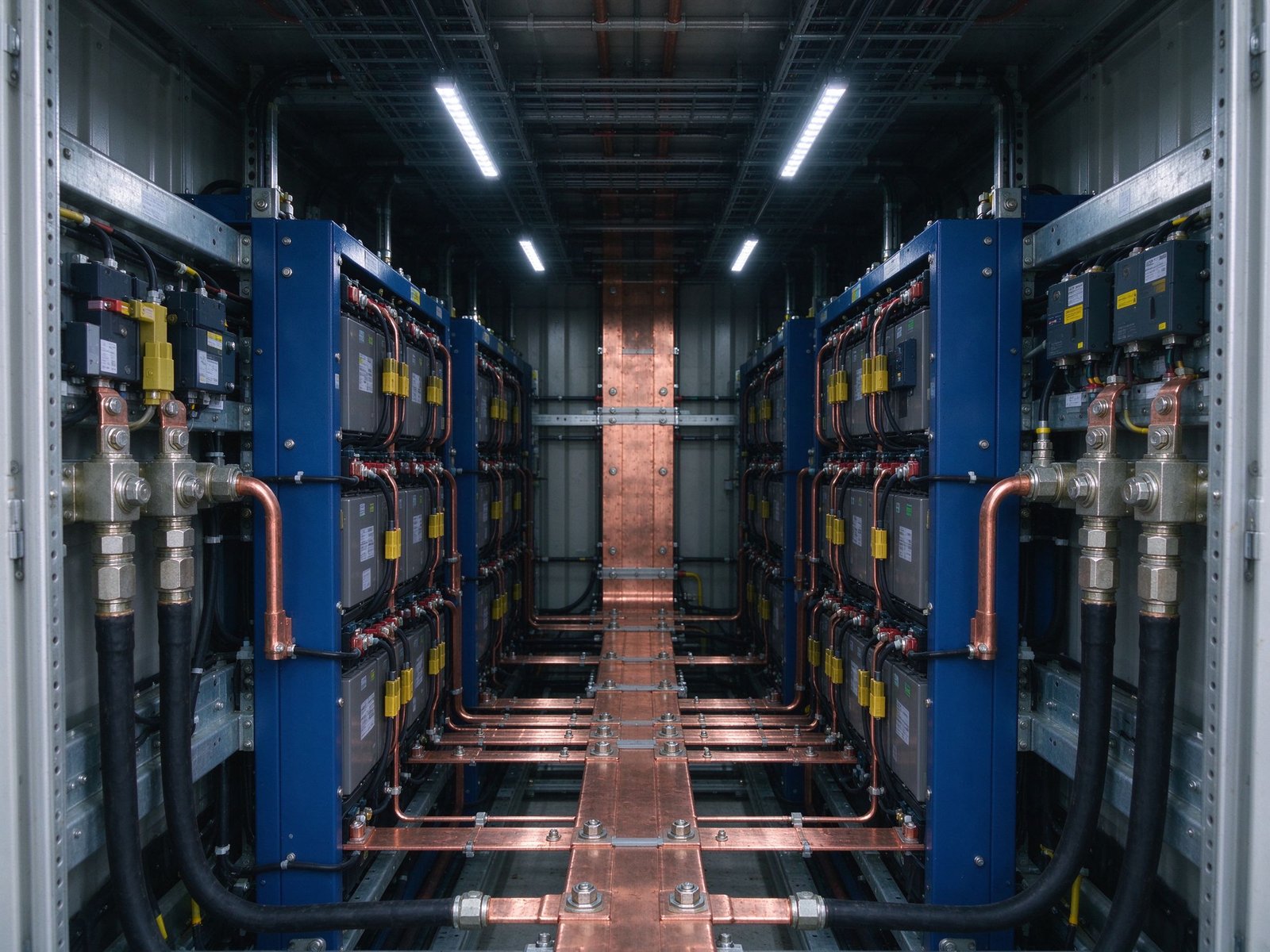
The 2026 PCS generation moves to larger blocks: 2.5–5 MW skids, 1,500 VDC links as the default for utility-scale, and higher switching-frequency SiC or IGBT stages for efficiency. Each block's DC-link busbar must carry 1,000–2,000 A per polarity at 1,500 V, hold loop inductance low for clean switching, and pass the temperature-rise budget in a sealed or forced-air skid.
The engineering method for that busbar — ampacity from temperature rise, inductance from geometry, insulation from IEC 60664-1 — is documented in the articles we published this week (ampacity and creepage), and the DC-link design in the ESS PCS DC-link article.
Utility-scale storage standardized on 1,500 VDC links in the current generation, cutting current per watt and cable cost versus 1,000 V systems. The DC-link busbar at 1,500 V carries a doubled insulation requirement — IEC 60664-1's 1.5× DC factor applied to the operating voltage — which pushes the laminate toward Nomex or epoxy-DLF dielectric build-ups and thicker insulation on the conductor edges.
Partial-discharge screening increasingly appears in PCS specifications at this class, a point covered in our insulation testing guide.
Inside a sealed or forced-air PCS skid, the DC-link busbar's temperature-rise budget is set by the neighboring components — capacitors, inductors, cabinets rated for 50–55°C ambient in many markets. Practical 2026 values: 1.2–2.0 A/mm² conductor density with forced-air, temperature-rise budgets of 30–40 K, and thermal verification on the assembled skid rather than the bare bar. The thermal management guide covers the stack-level calculation.
Below the PCS, the battery rack's own interconnect scales with the market: module-level laminates and cell-interconnect busbars at the cell level, and rack-level distribution busbars carrying hundreds of amps to the PCS. The 2026 trend is standardization — fewer, larger racks with busbar-integrated current sensing and fused tap-offs, driving DFM-ready laminate variants. The cell and module side is covered in our battery busbar product line and the EV battery busbar trends article.
The 2026 storage build-out happens against record copper prices — LME copper above $14,000/t in 2026 (see our copper supply article). For rack and PCS busbars the cost pressure is real, and the alternatives are quantified: aluminum conductors where the cross-section can grow and the joint technology accepts aluminum's plating and thermal behavior — the trade is in our aluminum versus copper article. In high-current PCS DC-links, copper laminates remain the default for conductivity and loop control; the savings appear at the rack distribution level.
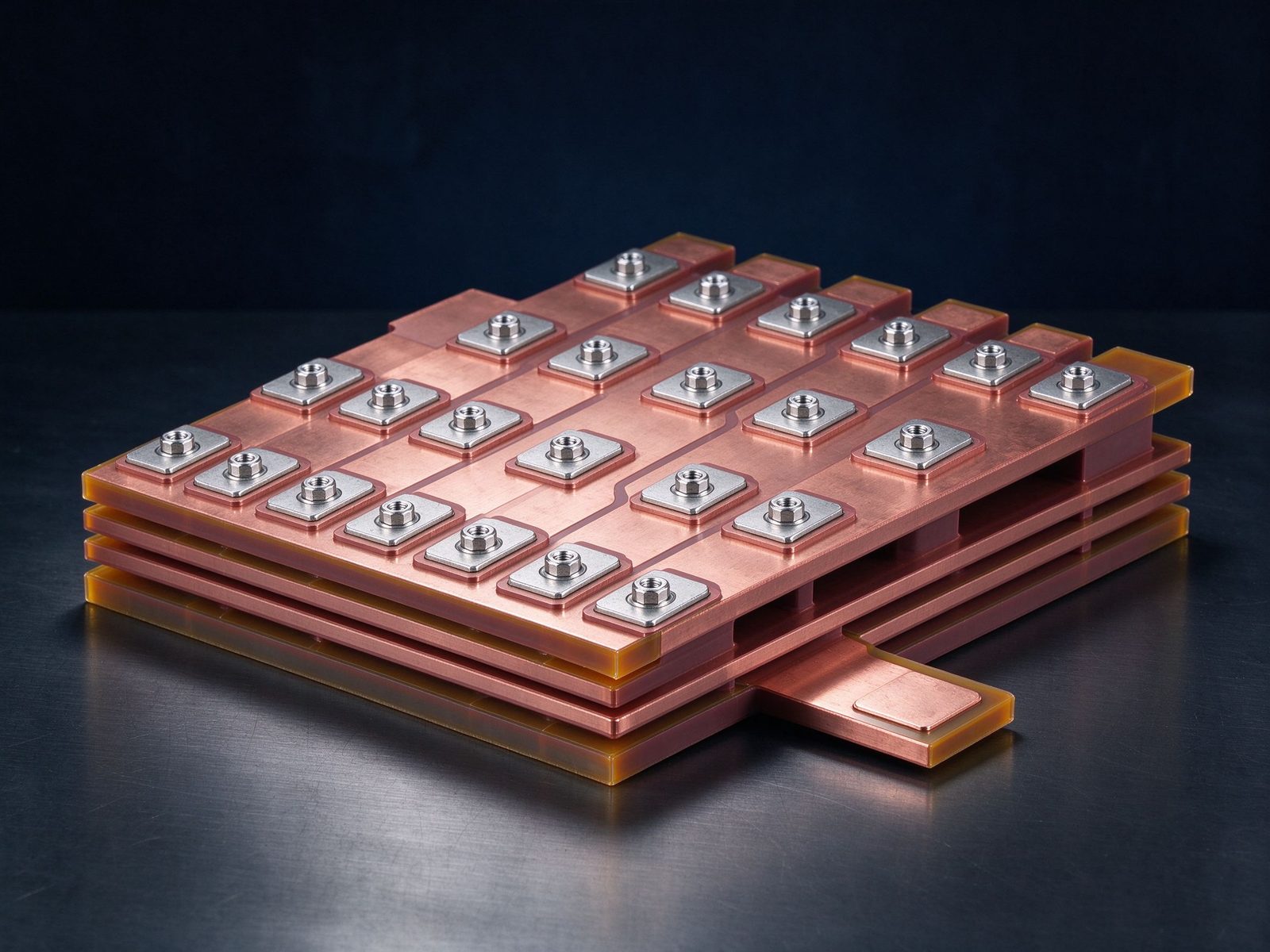
SiC adoption in storage PCS follows the inverter pattern covered in our SiC market article: faster switching, higher efficiency at partial load, and a loop-inductance budget that only laminates meet at 1,500 V. The 2026 PCS designs we review increasingly specify 10–20 nH total commutation loop, verified by double-pulse testing on the assembled DC-link.
The same physics that favors SiC favors the face-to-face busbar geometry that keeps the loop tight.
Storage projects cluster in high-temperature (Middle East, North Africa, US Southwest) and high-altitude (Andes, Tibetan plateau) sites. High ambient erodes the temperature-rise budget; altitude reduces convective cooling — both are derating levers quantified in our ampacity guide. The 2026 specification practice is to state the site class explicitly and run the busbar calculation for the worst case, not the catalog condition.
Export storage product must satisfy multiple codes: IEC 62477 (power conversion), UL 9540/UL 1741 for the US market, local grid codes for interconnection, and the component-level IEC 60664-1 insulation coordination for the busbar itself. Certification is a documentation exercise as much as a test exercise — material traceability, test records, and dimension verification per lot, the deliverables our quality system produces as standard.
A storage block fault feeds the DC-link from both the battery side and the PCS side; the busbar must survive the peak fault current until the protection operates. Electrodynamic force, support spacing and the Icw/Ipk declaration follow IEC 61439 practice — the complete method is in our short-circuit withstand guide published today. ESS-specific fault studies (both-sided feed) are part of our engineering support for rack and PCS builders.
BloombergNEF's 2036 forecast of 308 GW annual additions implies a supply chain that has industrialized: standard platform components, DFM-ready drawings, multiple qualified suppliers per part, and cost curves that reward volume. The busbar in that world is a platform product with documented variants — the direction our product lines and custom process are structured to serve.
Read the 2026 data as a buyer: volumes are doubling every few years (112→158→308 GW), voltage classes are standardizing at 1,500 V, thermal and mechanical requirements tighten with each skid generation, and supply chains are localizing. The component decisions made now — busbar architecture, materials, qualification — lock in cost and reliability for the 2027–2028 build-out.
158 GW in 2026, 308 GW in 2036: energy storage is now an industrial volume market, and its power electronics run on DC-link busbars that must carry more current, at 1,500 V, inside tighter thermal and cost envelopes, with documentation that travels across borders. The engineering methods to meet all four are published and standard — the execution is what separates suppliers.
Whether you build PCS skids, battery racks or complete storage blocks, the DC-link interconnect deserves the same engineering rigor as the converter itself. Talk to our application engineers with your platform parameters — current, voltage, envelope, site class — and get the laminate design and verification plan back as part of the inquiry.
SiC is scaling up — literally. Eight-inch wafer capacity is expanding at double-digit CAGR
Read article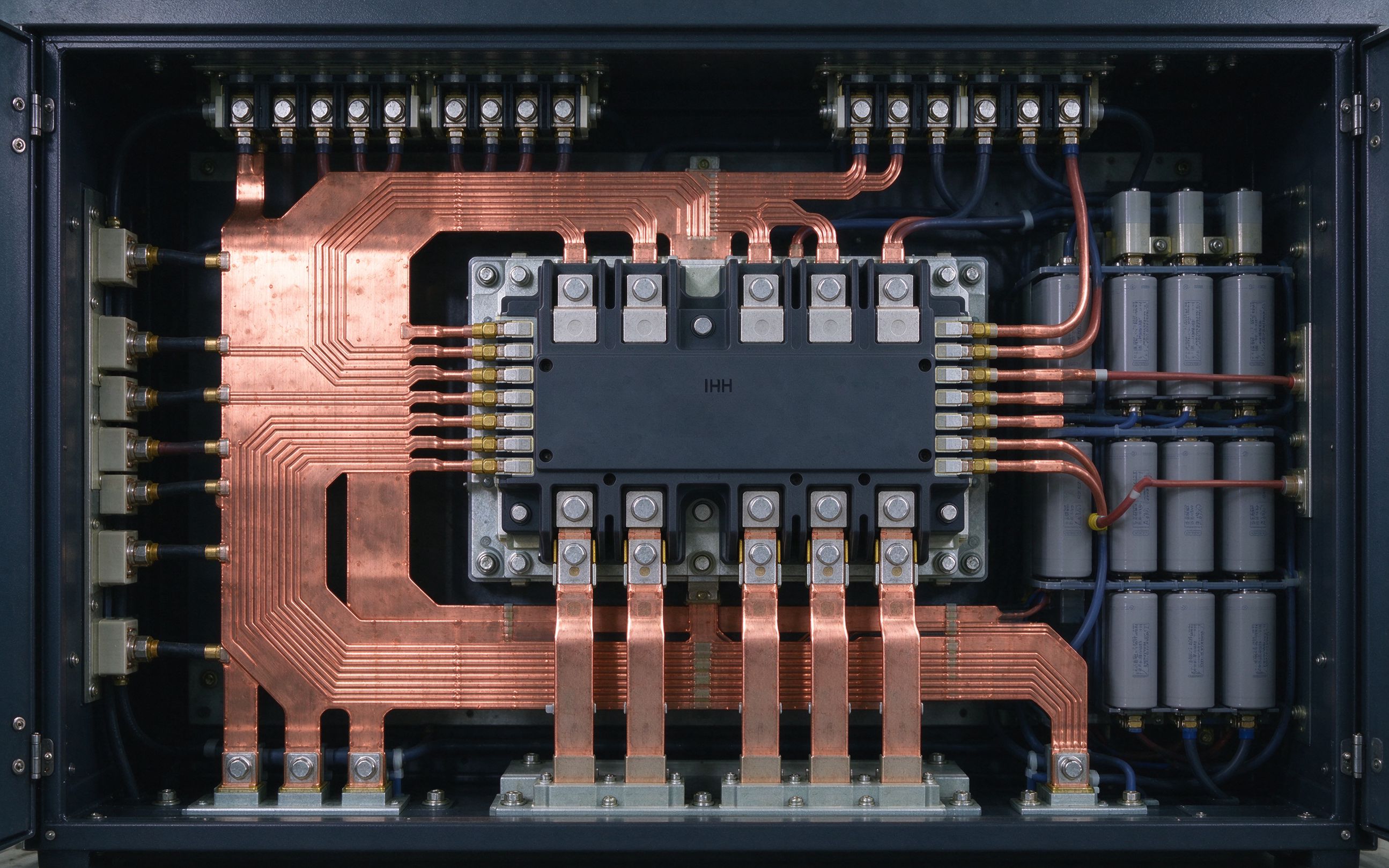
The inverter that dominated 2026's solar tenders is no longer a small box: 300 kW-plus str
Read article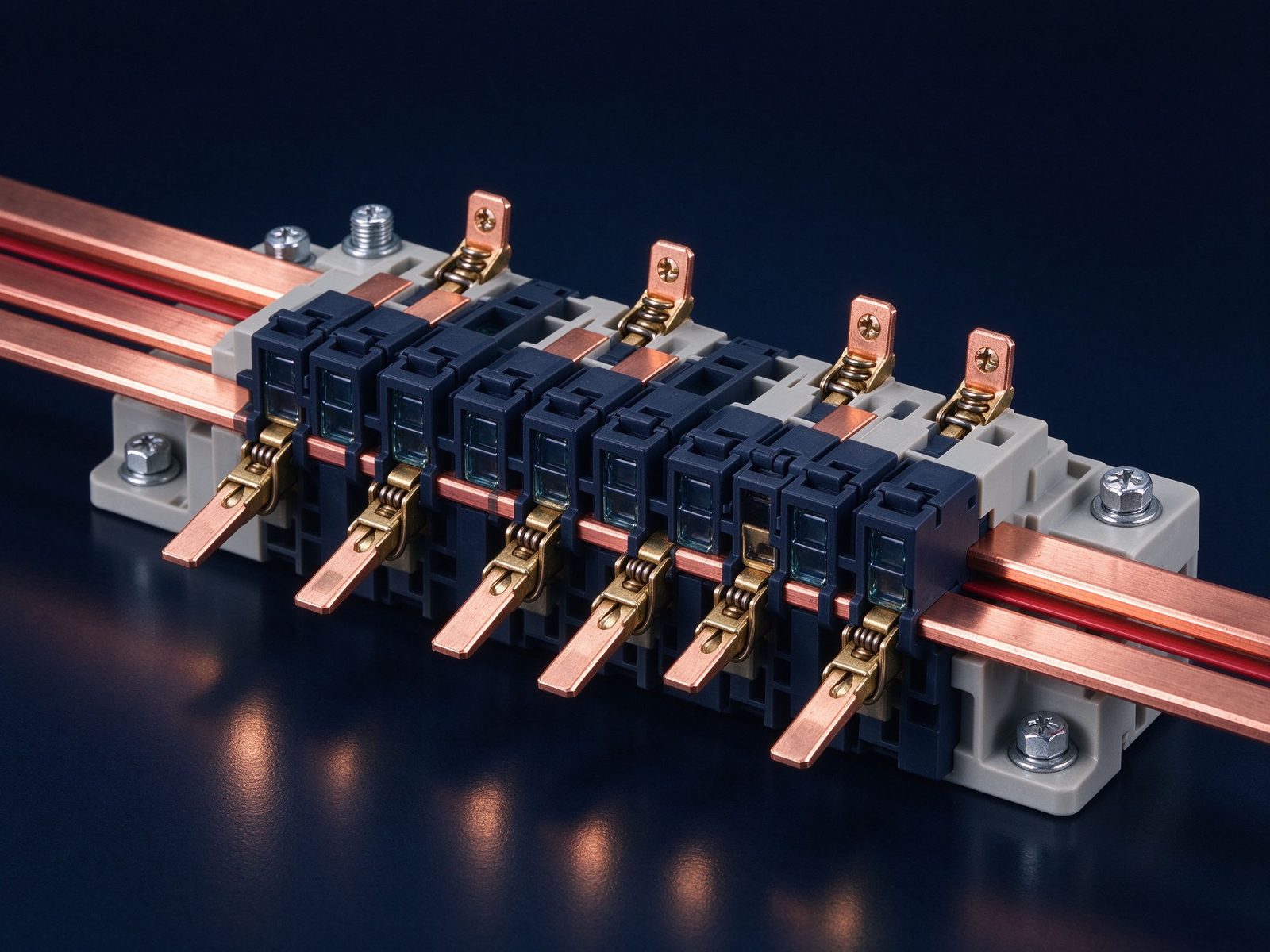
A short circuit is the busbar's worst moment: tens of kiloamps peak, forces in kilonewtons
Read articleSend the current profile, voltage class and terminal types — our engineers reply within one business day.