Copper conducts more in less space; aluminum weighs a third and costs far less. This guide compares the two on resistivity, creep behavior, joint design, weight and cost, and tells you how we decide which conductor to build your busbar from.
The question comes up twice on almost every program: once at the bill-of-materials stage, when copper prices move, and once at the weight-reduction review, when the vehicle or cabinet gets heavier. The honest answer splits into electrical, mechanical and thermal halves, and each half points a different way. Below is the full comparison we walk through with customers, starting from the reference numbers.
| Property | Copper (C11000) | Aluminum |
|---|---|---|
| Resistivity (annealed) | ≈ 1.72 × 10⁻⁸ Ω·m (100% IACS) | ≈ 2.82 × 10⁻⁸ Ω·m (≈ 61% IACS) |
| Density | ≈ 8.96 g/cm³ | ≈ 2.70 g/cm³ (≈ 30%) |
| Thermal conductivity | ≈ 370–401 W/m·K | ≈ 230–235 W/m·K |
| Mechanical behavior at joints | Good; tin plating, no creep issue | Soft in pure form; needs alloy at joints |
| Raw-material cost | Higher | Substantially lower |
| Typical role | High current density, high-duty traction and industry | Weight- and cost-sensitive distribution and packs |
Everything below expands on one line of this table. Our standard parts are built on C11000 copper, with aluminum available on request. The choice is yours, and we will tell you honestly which way a given design should go.
What does not change between the two materials is the laminated construction itself: thin conductors separated by dielectric films, bonded under heat and pressure, edge-sealed and terminated. Everything that makes a laminated busbar outperform a cable harness, low inductance, controlled PD, one-piece assembly, works the same whether the conductor web is copper or aluminum. The decision is purely about what the conductor web must deliver.
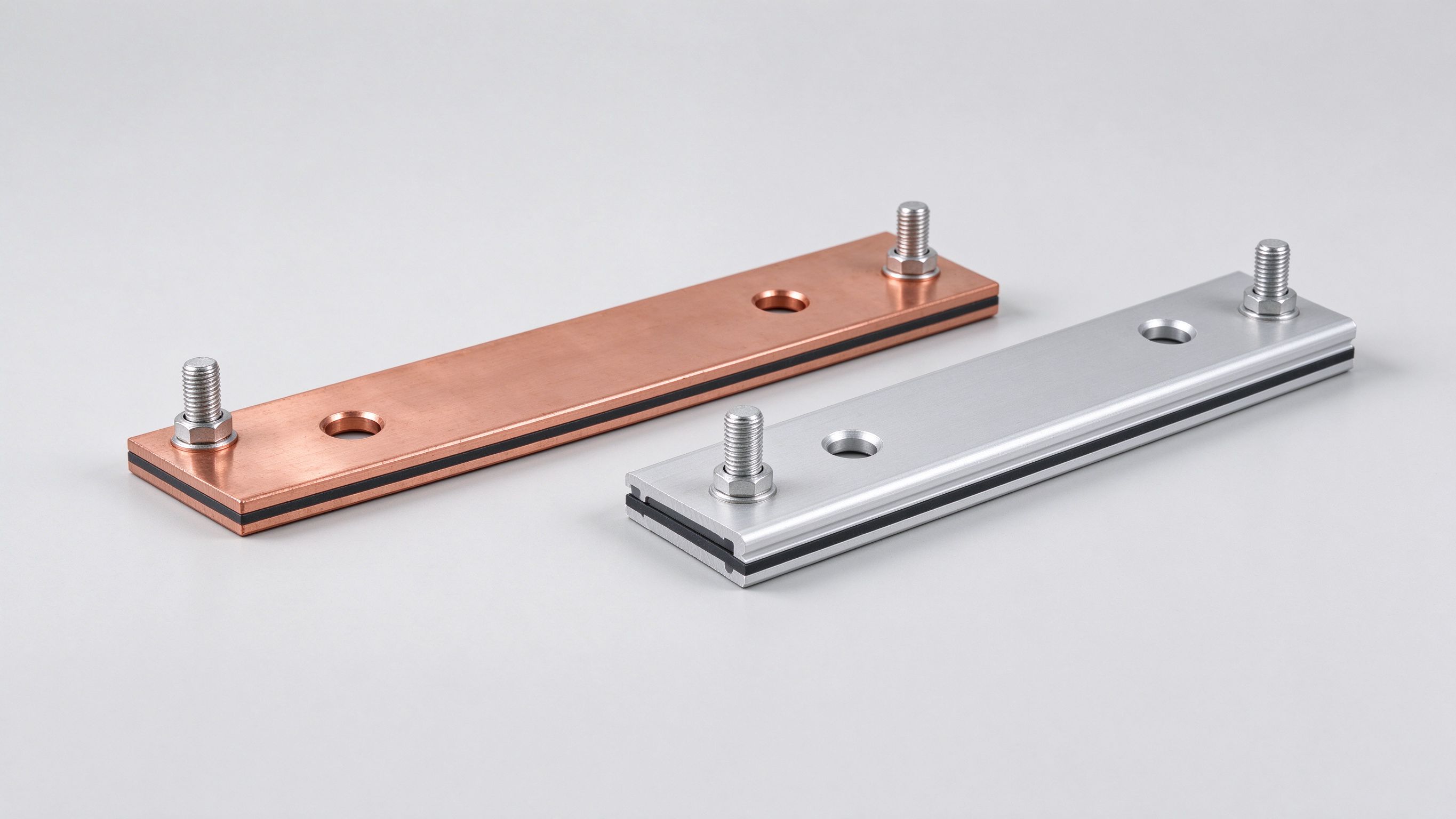
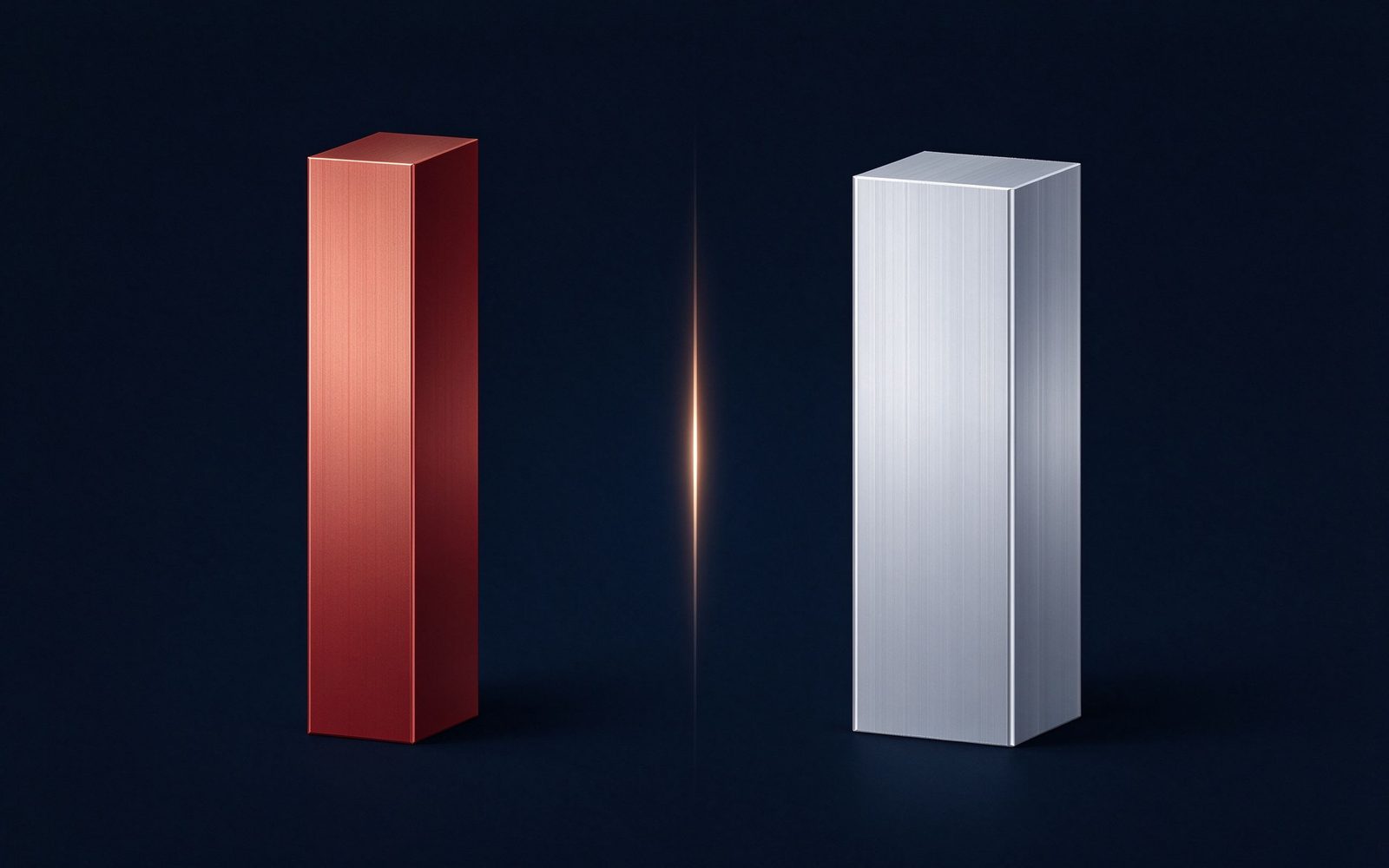
The arithmetic is simple but easy to under-appreciate. Aluminum conductivity is about 61% of copper's, so for the same resistance per meter you need about 1.6× the area. In a laminated busbar, that usually means thicker foil or one extra layer, which eats into the compactness advantage you were counting on.
At DC that is the whole story. At AC the skin effect nudges it further: current crowds toward the surfaces of thick conductors, and the lower-conductivity material suffers a proportionally heavier penalty on effective ampacity. The flip side is voltage drop: for long runs, an aluminum bar's higher resistance means a bigger voltage drop for the same current, which can matter for feeder busbars even when the temperature rise is fine.
Practical consequence: if your envelope is the binding constraint, inside an inverter or a charger cabinet, copper usually wins on density. If you have volume to spare and weight or raw-material cost is the target, aluminum's bigger section fits fine. Check your numbers against the copper busbar ampacity chart, then rescale the area by about 1.6× for an aluminum equivalent.
There is a second electrical subtlety at higher frequencies. AC current crowds toward conductor surfaces, and the thicker the bar, the more the inner metal sits unused. Copper's conductivity headroom is so large that the practical penalty falls on aluminum first: an aluminum bar sized at DC may still need more area once 50 or 60 Hz operation and proximity to adjacent bars are accounted for. Our ampacity table already carries the AC correction; apply the same 1.6× rescaling on top.
One practical sizing note comes out of the 1.6× number. If you are swapping an existing copper design to aluminum for a cost review, do not simply reuse the drawing and assume it will run cool: the same enclosure, with the same airflow, will run an aluminum bar hotter than the copper one. Often the cleaner path is to add a layer rather than uprate the existing web. Bring us the two cross-sections and we will show which path the thermal numbers take.
Electrical performance is only half the story. The classic aluminum problem is mechanical: pure aluminum is soft, and at a bolted connection the soft material slowly creeps under the clamp pressure. The joint relaxes, contact resistance rises, the joint runs hot, and the contact degrades further. This is the failure mode that gave aluminum wiring a bad name decades ago.
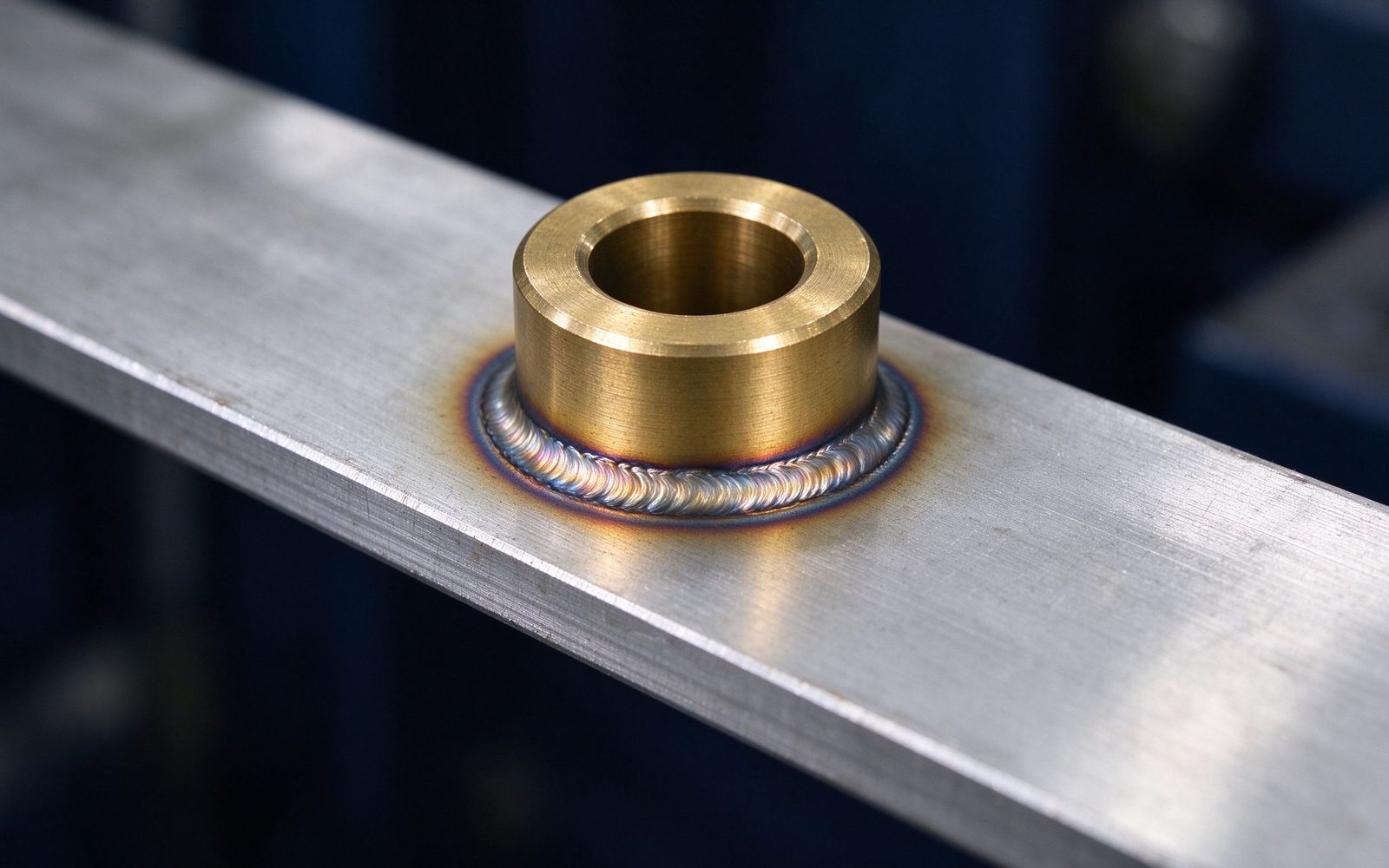
The laminated-busbar answer is a hybrid conductor design:
Why laser welding rather than bolting the alloy bushing on? The joint has to survive thousands of thermal cycles without relaxing. A mechanical joint between dissimilar aluminum grades invites a second creep path right where the two metals meet; a laser-welded fuse makes the interface continuous, the alloy bushing carries the bolt clamp, and the pure-aluminum web carries the current.
Contrast with our standard copper construction: C11000 sheet, tin-plated, bolted joints that stay stable for decades under clamp, no creep concern at all. The cost of going aluminum is therefore not just bigger area; it is engineered joint construction that a naive aluminum stack does not have, and that simplicity is why copper remains the default when current density or vibration is the binding constraint.
For the record, the old aluminum-wiring failures that industry still remembers were not bad aluminum; they were untreated aluminum joined like copper, with soft material clamped, oxidized at the contact surface, and never engineered against creep. A modern laminated aluminum busbar addresses each root cause: alloy at the clamp, nickel plating at the contact to keep oxidation off the mating face, and a welded interface that cannot loosen. The comparison worth making is not aluminum versus copper in the abstract, but engineered aluminum versus naive aluminum.
Aluminum's density is about a third of copper's. Where does the saving actually land? In a static cabinet, an aluminum busbar's mass saving is mostly a logistics story: cheaper freight, lighter rigging, easier assembly on site. In a moving platform, from EV battery packs to traction auxiliaries and commercial aviation enclosures, every kilogram removed from the power path is system-level range or payload, and over a vehicle's service life the CO₂ impact of moving less mass compounds.
Raw material is the other lever: aluminum sheet trades at a fraction of copper, and at laminate volumes that gap survives into the finished part price, even after the alloy-bushing engineering. Selective point plating keeps the finishing cost down compared with fully plated parts. Price volatility cuts the other way too: when copper spikes, aluminum programs get re-evaluated fast, and the reverse happens when it eases. Because the two conductor families share most of the same laminated process, switching between them mid-program is a DFM conversation, not a re-platform.
Typical uses where aluminum leads: battery pack and cell interconnections, charging station distribution, traction auxiliary systems, converter and inverter connections, and commercial aviation. In each case, weight and cost are prioritized over maximum current density, which is the right trade, provided the joints are engineered as above. Charging stations are a characteristic middle case: the cabinet is static, so raw weight matters little, but raw cost and the sheer length of the distribution bus make aluminum attractive, and the alloy-bushing joint design keeps the connection reliable. For the supply-chain side of the copper price argument, see our note on copper price and busbar supply for 2026.
Copper's thermal conductivity, 370–401 W/m·K, beats aluminum's, 230–235 W/m·K, by about 60%. As we show in the thermal management guide, though, internal conduction resistance inside a busbar is not the thermal bottleneck: both metals spread heat extremely well, and the temperature drop across even a 10 mm conductor is hundredths of a degree.
Where the difference shows up is at the margins: an aluminum bar carrying the same current as a copper bar runs at a higher temperature rise, because its larger area only partly compensates, and its polished surface radiates even less. The practical procedure we follow: size the aluminum conductor with an extra temperature margin over the copper equivalent, specify the outer surface treatment so emissivity is high, because a painted or laminated outer face radiates far better than polished aluminum, and check the joint temperatures specifically. The alloy bushing runs the same current but at a different temperature, and it is the joint, not the mid-span bar, that sets the long-term limit.
If your cooling design is tight, run the thermal numbers explicitly rather than assuming copper and aluminum are thermally interchangeable. If the enclosure has margin, aluminum's thermal gap rarely shows up. Do not over-rotate on the thermal difference: because internal conduction is not the bottleneck, swapping copper for aluminum rarely creates a thermal problem by itself; it changes the numbers you have to check, mainly the joint temperature and the surface emissivity. The failures we see on aluminum parts come from joints that were designed as if aluminum were stiff, not from the metal running too hot. At a bolted joint, contact resistance is a small but real heat source, and the joint is where the conductor must carry current into the external bus; the mid-span bar will be fine, and the joint is the measurement point we watch on aluminum designs. That is the point we temperature-check on first article, with the busbar carrying rated current.
Send us the current profile, envelope and duty cycle, and we will work through the trade. As a default read:
A third option exists and we use it: aluminum main conductors with engineered connection points built for the joint loads. The material choice then becomes a point-by-point decision, not a whole-part one. Whatever direction the trade points, the conductor question should be closed at DFM stage, because it changes cross-section, plating, terminal construction and tooling all at once. Remember that the choice also ripples into finishing: tin plating is the standard joint finish on copper, while aluminum's joint engineering leans on selective nickel plating at the bushings. Build both into the cost model early, not after the quote comes back.
We build power-electronics busbars in copper or aluminum to your drawing, and the conductor choice is one of the first questions in design guide DFM review. Whether you land on copper or aluminum, the laminated construction underneath is the same, and so is the quality process around it. Bring us the two budget options, copper section versus aluminum section, and your thermal and vibration targets; we will tell you which one the numbers choose before any steel is cut, via contact engineering.
Send the current profile, voltage class and installation conditions — we will size the busbar and document the calculation with your quotation.
Send the current profile, voltage class and installation conditions — we will size the busbar and document the calculation.