A laminated busbar can pass a 3 kV hi-pot test and still fail in service - because a dielectric withstand test asks a different question than a partial discharge test. Understanding which test answers which question is what separates a busbar specification that protects a 20-year warranty from one that only looks rigorous. This guide walks through the four core insulation tests applied to laminated busbars, the standards behind them, and the acceptance logic a buyer should use.
A laminated busbar can pass a 3 kV hi-pot test and still fail in service - because a dielectric withstand test asks a different question than a partial discharge test. Understanding which test answers which question is what separates a busbar specification that protects a 20-year warranty from one that only looks rigorous. This guide walks through the four core insulation tests applied to laminated busbars, the standards behind them, and the acceptance logic a buyer should use.
Every insulation test in the busbar world answers one of four questions. (1) Dielectric withstand (hi-pot): can the insulation survive a defined over-voltage without breakdown? (2) Partial discharge: does the insulation discharge at all while operating at its real working voltage? (3) Insulation resistance: does the insulation hold a minimum resistance under DC measurement, including after humidity or thermal ageing? (4) Impulse withstand: does the stack survive the transient overvoltages of switching and lightning?
None of the four substitutes for another. A thick film with a void can pass hi-pot (the test voltage is applied briefly and the void may not break down), yet discharge continuously at operating voltage and erode until failure. A high insulation resistance reading can coexist with a sharp edge that discharges at every switching event. The standards framework - IEC 60664-1 for insulation coordination, IEC 60270 for PD measurement, UL 1973 and UL 1977 for battery and connector systems - exists precisely to make all four questions answerable in a specification.
The dielectric withstand test applies an AC (or DC) voltage between conductors and between conductors and ground, holding it for a defined period while monitoring for breakdown or excessive leakage current. IEC 60664-1 lists the AC power-frequency voltage test as one of the core routine tests; for battery systems, UL 1973 specifies values such as 3000 V AC for 60 seconds on systems with a 1500 V working voltage, and accepts DC testing at 1.414x the AC value.
For laminated busbars the practical choices are: test voltage (typically 2x working voltage plus margin, or the UL/rated-class value), test duration (typically 60 s for type tests, 1-5 s for routine production tests), and the acceptance criterion (no breakdown; leakage below a defined limit). Production hi-pot testing is non-destructive when the applied voltage is chosen correctly, and it catches layer-to-layer defects, contaminated edges and assembly errors before shipment. SHANYUAN applies hi-pot as a 100% routine test on busbar series production, per the quality system.
Partial discharge (PD) is a localised electrical discharge that partially bridges the insulation - it does not immediately short the busbar, but it erodes the dielectric over time. In laminated busbar stacks, PD typically initiates at voids, sharp conductor edges, or dielectric cut lines where the electric field concentrates. At 800 V automotive platforms and 1500 V storage systems, PD-free operation at working voltage is becoming a contractual requirement, and the measurement method follows IEC 60270.
The test procedure is: apply a gradually increasing AC voltage, measure the discharge magnitude in picocoulombs, and determine the partial discharge inception voltage (PDIV) - the voltage at which discharge starts - and the extinction voltage (PDEV). Acceptance criteria typically require no discharge above a threshold (often 5-10 pC) at the working voltage plus margin. Because PD behaviour is highly sensitive to dielectric thickness, edge geometry and pressure, the test is both a design tool (catch it in development) and a quality gate (sample or 100% on critical parts). For a deeper look at failure modes, see the dielectric selection guide.
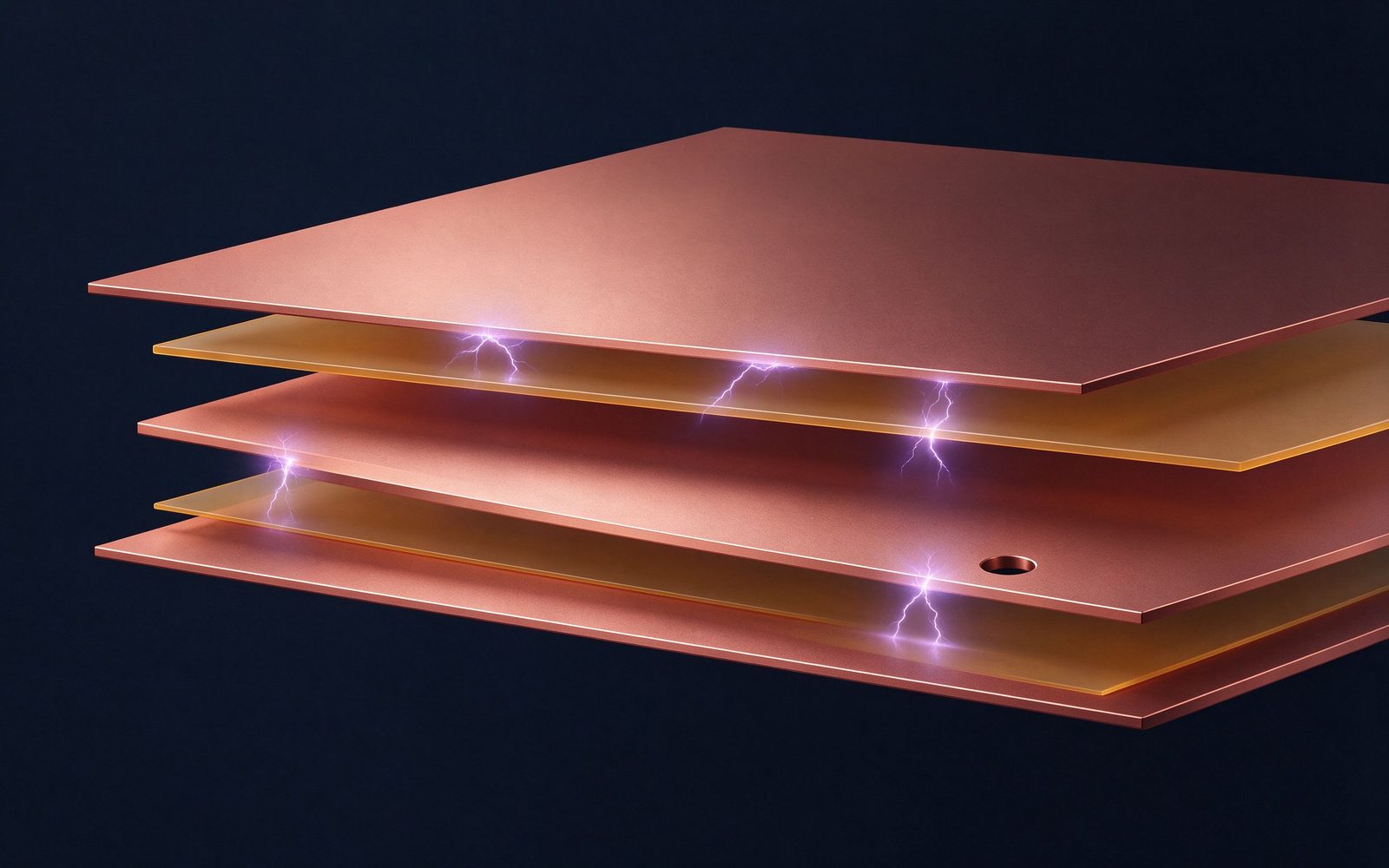
Insulation resistance (IR) is measured with a megohmmeter applying a DC voltage and reading the resistance after a stabilisation period. UL 1973 requires insulation resistance to exceed 1 MΩ per volt of working voltage - so a 1500 V system needs more than 1.5 GΩ. The test is sensitive to humidity and surface contamination, which is why it is specified both at room temperature and after high-temperature/humidity conditioning; a busbar that passes IR dry but fails after 85% RH is telling you about surface creepage paths, not bulk dielectric.
For busbar buyers the practical point is to look at the whole matrix: IR at room temperature, IR after humidity, and IR after thermal ageing. These three readings together characterise the surface and the dielectric better than a single number. Suppliers that publish the full matrix - as SHANYUAN does for series production - make the 20-year reliability argument concrete.

Switching transients in power electronics are fast and brutal: a SiC inverter can generate dV/dt above 50 V/ns, and motor-drive or grid installations add lightning-derived impulses. IEC 60664-1 defines impulse voltage tests with standardised 1.2/50 µs waveforms, and the required impulse withstand grows with the overvoltage category of the installation. The busbar stack must survive these impulses without dielectric breakdown - which in practice means the insulation coordination (clearance, creepage, material class) was designed for the category, not improvised.
Impulse testing is a type test rather than a routine test, but its result feeds directly into the clearance and creepage rules that every design uses. This is why the same insulation coordination logic appears in DFM checklists and in application-specific guidance like the partial discharge resource page.
| Test | Standard | Typical acceptance (example) |
|---|---|---|
| Dielectric withstand (hi-pot) | IEC 60664-1 / UL 1973 | 3000 V AC 60 s on 1500 V systems; no breakdown; DC at 1.414x |
| Partial discharge | IEC 60270 | ≤5-10 pC at working voltage; PDIV > working + margin |
| Insulation resistance | UL 1973 | >1 MΩ/V of working voltage (e.g. >1.5 GΩ at 1500 V) |
| Impulse | IEC 60664-1 | 1.2/50 µs waveform; no breakdown at category level |
Acceptance values in a real specification are project-specific - the table shows the reference logic. When comparing supplier quotes, ask for the test matrix against these same standards rather than generic 'tested to UL' statements.
Type tests (design qualification), routine tests (100% production) and sample tests (lot acceptance) form a three-layer pyramid. Type tests validate the design: full hi-pot, PD, IR, impulse, thermal cycling and humidity. Routine tests run on every part: hi-pot at a reduced level, continuity, visual inspection. Sample tests run per lot: IR after humidity, terminal torque retention, dimensional verification.
For high-reliability programs (storage, charging, traction) SHANYUAN runs the full pyramid and documents it in the PPAP package. For prototype and low-volume custom parts, the custom design service includes the type-test evidence as part of the design review, so the buyer knows the insulation margin before committing to series tooling.
A production PD test on a laminated busbar needs a clean, repeatable setup. The busbar under test is placed on insulating supports; a PD-free test transformer applies the AC voltage between the power planes (or power-to-ground); a coupling capacitor and PD detector in the measurement branch sense discharge pulses in picocoulombs; and the environment must be shielded and, for sensitive measurements, humidity-controlled. Because the busbar's own capacitance is part of the circuit, the calibration step - injecting a known charge at the busbar terminals - is essential before every test series.
The practical trap is connection hardware: test leads and clamps introduce their own discharges, so terminals must be clean and the connections shielded. This is why PD testing is best done in a dedicated fixture rather than a general-purpose hi-pot station. For series production, SHANYUAN uses dedicated PD fixtures for the critical voltage classes and applies hi-pot as the 100% routine gate - the combination that keeps both throughput and engineering confidence.
A supplier that publishes this matrix - as SHANYUAN does in its quality documentation - turns the test report into a design document rather than a compliance stamp.
Good insulation design makes good testing possible. Four choices stand out. First, edge design: filleted or rounded conductor edges reduce field concentration, which both improves PD performance and stabilises test results. Second, dielectric thickness control: consistent thickness across the stack produces consistent PDIV, so the acceptance band is meaningful. Third, terminal design: accessible, clean test points avoid setup-induced discharges. Fourth, material selection: dielectrics with stable dielectric constant and low void content (PET, Nomex, DLF families) keep PD behaviour predictable.
The same choices appear in the DFM checklist and in dielectric selection guidance - testing is the verification layer on top of design intent. For 800 V and 1500 V platforms, this design-for-testability discipline is what allows a manufacturer to guarantee discharge-free operation in series rather than in prototypes only.
Insulation does not fail on day one; it fails after years of thermal and moisture cycling. The qualification suite therefore includes thermal cycling (typically -40 to +105 °C, or application-specific ranges) with periodic hi-pot and IR measurements after every cycle block, and humidity exposure (for example 85% RH, 85 °C for defined durations) followed by IR and hi-pot. A dielectric that passes these tests with stable margins is one that will hold its clearance and creepage behaviour in service.
The failure signatures matter for interpretation. A slow IR decline across thermal cycles points to surface contamination or dielectric degradation at the edges; a sudden hi-pot failure points to a crack or delamination. PD measurements after thermal cycling catch void growth inside the stack - the mechanism that leads to mid-life failure in field-wound or poorly laminated constructions. This is why SHANYUAN's qualification matrix for multi-layer insulated busbars always includes the environmental block, not just the electrical tests.
| Parameter | 800 V automotive | 1500 V storage |
|---|---|---|
| Working voltage | up to 800 V (typ. 400-800) | up to 1500 V (typ. 1000-1500) |
| Hi-pot example | 2x working + margin, e.g. 2.5-3 kV | UL 1973-style, e.g. 3000 V AC 60 s |
| PD requirement | PD-free at working + margin (increasing) | PD-free at working voltage, contractual |
| IR requirement | >1 MOhm/V | >1 MOhm/V (e.g. >1.5 GOhm) |
| Environmental block | -40 to +105 C, humidity | storage ambient + humidity + thermal cycling |
The table summarises the direction: higher working voltages tighten every acceptance value, and the trend across 2026 is for automotive to adopt the storage-grade discipline (PD-free, environmental blocks) rather than the reverse. Buyers should specify the working voltage and the environmental envelope explicitly - the partial discharge resource and the dielectric selection guide provide the technical baseline.
The qualification pyramid keeps cost proportional to risk. Type tests qualify the design once: full hi-pot, PD, IR matrix, impulse, thermal cycling and humidity - the evidence that the stack-up is sound. Routine tests run on every production part: hi-pot at the production level, continuity, visual inspection, and where specified a fast IR check. Sample tests run per lot: IR after humidity on a statistical sample, terminal torque retention, dimensional verification, and periodic destructive checks (cross-section of welds, peel tests).
The pyramid only works if the levels are linked: a design change triggers a type re-test; a routine failure triggers a lot hold and root-cause; a sample failure triggers expanded sampling. For high-reliability programs (storage, charging, traction), buyers should ask for the pyramid documented in the PPAP package - type-test evidence, routine-test records and the sampling plan. SHANYUAN structures exactly this documentation in its quality system, so the buyer's audit starts from a complete evidence trail rather than a single certificate.
Each pitfall is visible in supplier documentation: if the report is a single certificate without method, environment and sample identity, it is not evidence - it is a compliance stamp. The quality system page shows the evidence structure buyers should expect.
Qualification testing is a collaboration, not a handoff. The buyer's specification sets the working voltage, environmental envelope and acceptance values; the supplier's laboratory executes the matrix; and the buyer (or a third-party lab) witnesses the critical tests. Three practical agreements make the collaboration clean. First, agree the sample plan: how many parts, from which lots, and how failures trigger expanded sampling. Second, agree the witnessing scope: which tests are witnessed (typically PD and environmental blocks) and which are reported. Third, agree the failure procedure: hold, root-cause and re-qualification steps that follow a failed test.
The evidence trail from this collaboration is what a downstream customer or an auditor will ask for: the specification, the method statements, the test records with sample identity, and the disposition of any failures. Structuring it as part of the quality system - as SHANYUAN does for series programs - means the qualification survives the audit intact.
No. Hi-pot proves withstand, not discharge-free operation. At 800-1500 V, partial discharge testing at working voltage is the test that predicts field life.
Partial discharge inception voltage - the voltage at which discharge starts. Designs aim for PDIV well above the working voltage plus margin.
As a 100% routine test on series production; type tests additionally cover impulse, PD, IR and environmental conditions.
Surface moisture creates creepage conduction paths; the humidity IR test characterises surface design and is a standard qualification step.
Apply the same discipline to thermal management, understand how the dielectric is chosen in dielectric selection, and see how connections are joined in welding and joining. Market context is in the 2026 market outlook.
Insulation testing is ultimately a translation exercise: translating a 20-year reliability requirement into a set of measurable, repeatable, documented tests. The busbar that passes the full matrix - hi-pot, PD, IR with environmental blocks, impulse, thermal cycling - is a busbar whose warranty argument is engineering, not hope.
The standards cited throughout - IEC 60664-1, IEC 60270, UL 1973 and UL 1977 - are the shared language between supplier and buyer; using them precisely is what makes a 20-year reliability argument auditable.
Used consistently, the four insulation tests - withstand, partial discharge, insulation resistance and impulse - give a laminated busbar a verifiable electrical identity, and that identity is what survives an audit, a warranty claim or a decade in the field.
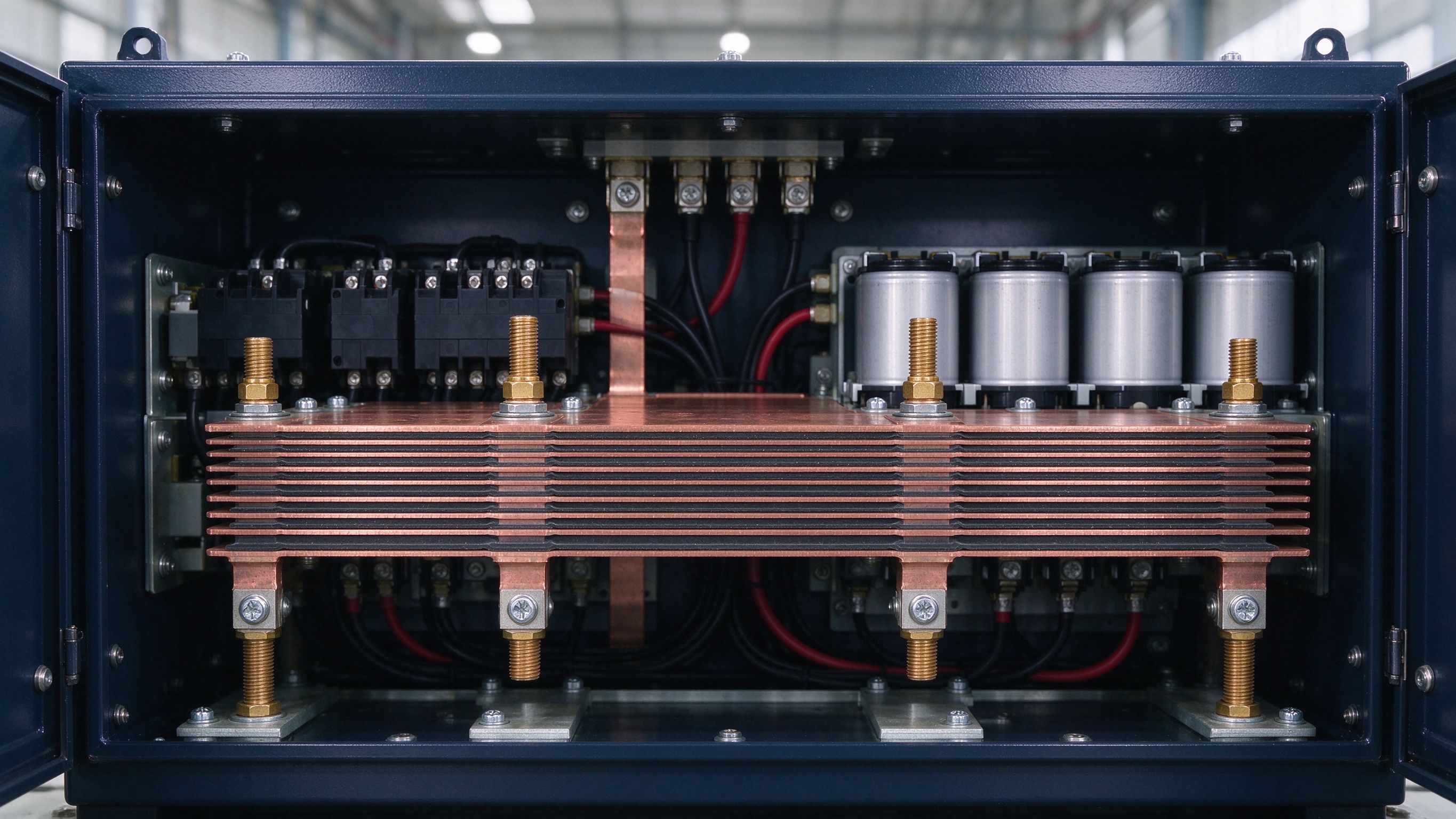
MCS moves from pilot to fleet scale in 2026: 1 MW+ charging at 1250 V and up to 3000 A mak
Read article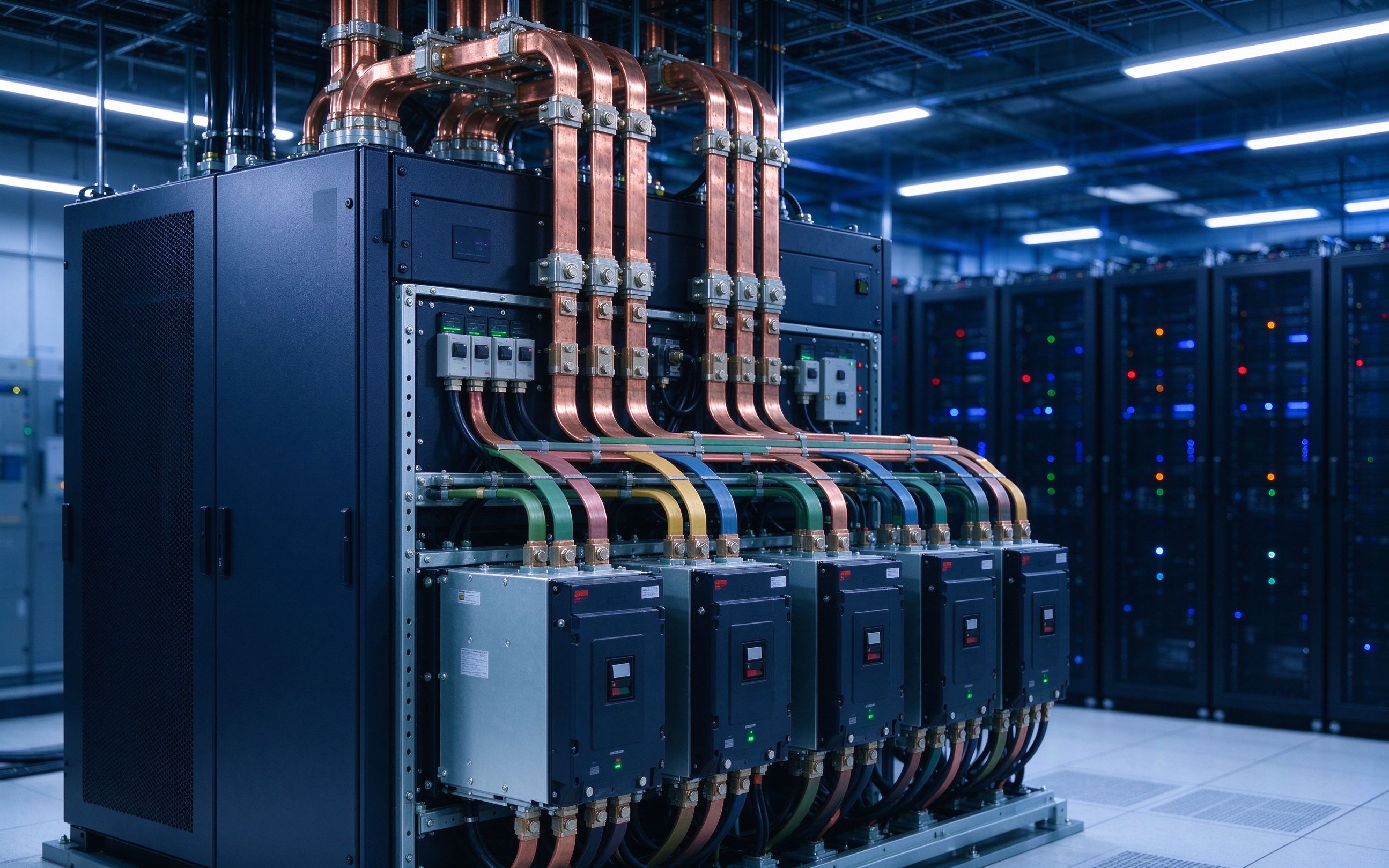
BloombergNEF sees 158-188 GW of new energy storage in 2026. PCS platforms are climbing fro
Read article
Multiple forecasters put the laminated busbar market near USD 1.0-1.06 billion in 2026, wi
Read articleSend the current profile, voltage class and terminal types — our engineers reply within one business day.
Send drawings, current ratings and voltage class — DFM feedback and a quotation within one business day.