A purchasing manager asking whether to buy a flexible busbar or a rigid laminated busbar is really asking a different question: where will this connection live, and what will it be asked to absorb? A rigid laminated bar delivers lowest cost, tightest impedance and a clean structure when the layout is fixed — think inverter DC-links, switchgear, UPS cabinets. A flexible busbar made of stacked copper foil absorbs vibration, thermal expansion and installation tolerance — think EV battery packs, wind turbines, robots and anything that moves. This guide turns that trade-off into a decision framework: a comparison matrix, condition-to-recommendation mapping, and the RFQ data package that gets you a comparable quote from any supplier.
A purchasing manager asking whether to buy a flexible busbar or a rigid laminated busbar is really asking a different question: where will this connection live, and what will it be asked to absorb? A rigid laminated bar delivers lowest cost, tightest impedance and a clean structure when the layout is fixed — think inverter DC-links, switchgear, UPS cabinets. A flexible busbar made of stacked copper foil absorbs vibration, thermal expansion and installation tolerance — think EV battery packs, wind turbines, robots and anything that moves. This guide turns that trade-off into a decision framework: a comparison matrix, condition-to-recommendation mapping, and the RFQ data package that gets you a comparable quote from any supplier.
A busbar connection is specified once and lives for the life of the product. In a fixed cabinet, a rigid laminated busbar with proper torque control delivers decades of service — industry experience puts well-maintained rigid systems in the 30-year range. In a moving system, the same rigid bar transmits every vibration and thermal cycle into the cell terminals, connectors or solder joints, and that is where fatigue failures start. Flexible foil construction converts that mechanical energy into benign micro-flexing instead of stress concentration. So the first step of the procurement decision is not cost — it is the mechanical duty the connection will actually see. The flexible busbar engineering notes on this site give the construction details behind that trade-off.
Vibration resistance: rigid bars transmit vibration to the joint and can fatigue cell terminals and bolts; flexible foils absorb it through multi-layer damping — the decisive difference in EV packs, robots and marine equipment. Thermal expansion: a long rigid bar expands against its constraints; foil stacks bend and take up the dimensional shift. Tolerance absorption: flexible bars bridge assembly misalignment and stack-up; rigid bars need the whole chain toleranced tightly. Impedance and current: rigid laminated construction gives the lowest loop inductance and best field cancellation; flexible bars run slightly higher inductance per length but still far below cabling. Cost: rigid is cheaper per amp in volume — stamping, lamination and simple fixtures; flexible adds foil stacking, welding and more process care. Space: both are compact; flexible wins where the path bends. The decision matrix in the design guide applies this comparison to real layouts.
Choose rigid laminated construction when four conditions hold: the layout is fixed and will not move in service; the environment is low-vibration (a cabinet, a rack, a fixed converter); cost and repeatability matter more than installation forgiveness; and you want the lowest possible loop inductance, as in IGBT and SiC inverter DC-link busbars. Rigid parts stamp cleanly, laminate into flat multi-layer assemblies, and fixture reliably on a line. They are also the natural choice where the busbar itself carries structure — standoffs, mounting brackets, connector lands. For a procurement team, rigid is the default: lower tooling risk, simpler inspection, and well-understood cost curves. The laminated busbar product line covers this architecture.
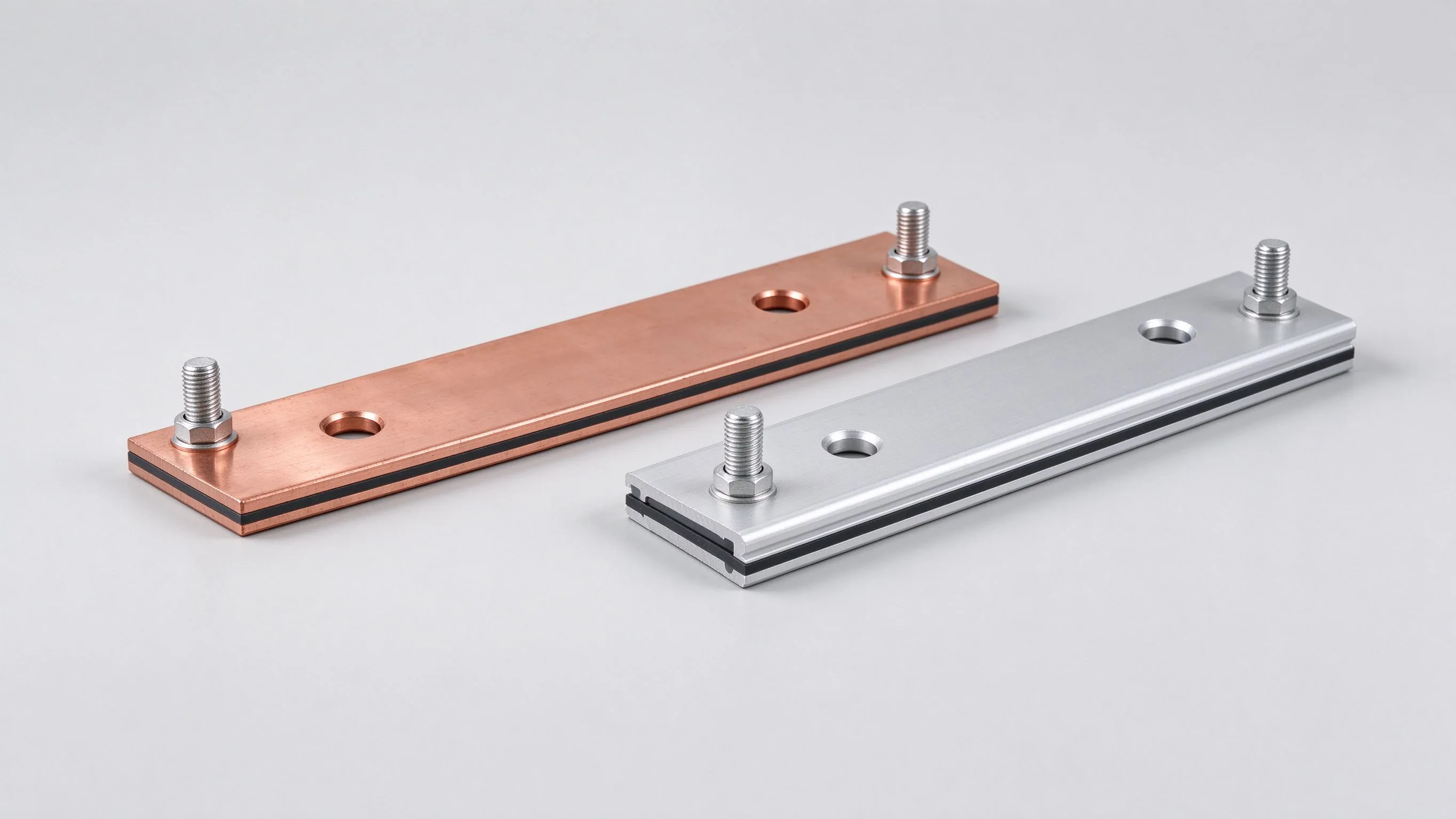
Switch to flexible when the system moves, expands, or cannot hold tight tolerances: EV and ESS battery modules where cells breathe and the pack vibrates; wind turbines and generator connections with continuous flex; robots and any jointed mechanism; and field-service connections where a rigid bar would need perfect alignment to install. Rigid bars in these settings crack cell ceramic seals and connector solder joints; foil busbars act as a bellows that absorbs the micro-movement. The high-current flexible busbar range is engineered for exactly these paths, and the insulated flexible version adds dielectric protection for longer routes.
Most real systems are hybrids. The standard pattern is a rigid laminated backbone — the torso bus, the rack bus, the inverter DC-link — with flexible jumpers at the interfaces that move: module-to-rack, pack-to-PCS, joint-to-joint in a robot. The rigid section carries the bulk current with minimum inductance; the flexible section absorbs alignment and movement where the two subsystems meet. This is the architecture SHANYUAN builds most often, and the custom design route exists precisely so a procurement team can specify the split rather than inherit it. A hybrid also simplifies assembly: the rigid parts bolt into fixed fixtures, the flex parts bridge the last few millimeters.
The construction of a flexible busbar is worth understanding before buying, because it sets the cost and the failure modes. A typical flexible bar is a stack of 0.1–0.3mm copper foils, laminated or welded at the ends into a solid tab, then plated; the foil stack gives the bendability, the welded tab gives the connection surface. Foil thickness, layer count and tab length determine both the current capacity and the flex life — thinner foils flex longer but add process cost and reduce cross-section per layer. Insulated flexible bars add a dielectric wrap or coating along the length while leaving the tabs bare. The three specifications a buyer must pin down are foil grade and thickness, layer count, and tab plating — the product range shows the standard build options and the custom route handles the rest.
Rigid laminated cost is driven by copper weight, stamping die amortization and lamination process time; tooling is the up-front item and per-part cost falls steeply with volume. Flexible cost is driven by foil handling, welding (ultrasonic or resistance), and the care required to keep layer alignment and plating quality — process content is higher, so per-part cost is higher at every volume. The procurement question is therefore where the money goes: a rigid system spends up front on tooling and saves per part; a flexible system spends per part and saves on assembly tolerance, rework and field failures. At the volumes of a battery module program, flexible is routine; at the volumes of a switchgear line, rigid dominates. Either way, the quote should state both the tooling charge and the per-part price separately, which is one of the nine items in a complete connector selection RFQ package.
The material dimension of the hybrid deserves one more sentence. A hybrid architecture also lets a design team mix materials deliberately: copper where transients and joint reliability dominate, aluminum where steady-state current and weight win, with bimetallic transitions at the interface. The flexible jumpers can be copper where they bend most and aluminum where they are straight. This is material allocation as a design tool, and it is one of the reasons the flexible-vs-rigid decision is really an architecture decision rather than a component decision.
Engineers over-index on conductivity and under-index on inductance. A rigid laminated pair with interleaved planes cancels field and achieves very low loop inductance — critical at inverter switching frequencies where stray inductance converts to voltage spikes. A flexible foil stack has slightly higher inductance per meter but still an order of magnitude below a cable harness, and its multi-layer form carries high current in a compact section. Current capacity follows the same ampacity rules as rigid — cross-section, cooling and the 30 °C-rise criterion set the limit — but foil stacks typically run more surface area per cross-section, which can help heat rejection. When comparing quotes, ask for the calculated temperature rise at your duty current, not just the cross-section number.
The cost comparison also has a hidden line: assembly labor and rework. A rigid busbar with tight positional tolerances can fight the rest of the assembly — the holes never quite line up, the standoffs shim, the torque sequence takes twice as long. A flexible bar simply bends to fit, which is why field-service teams and low-volume assemblers often prefer it even when the per-part price is higher. The honest procurement view is a total-installed-cost comparison: part price plus tooling amortization plus assembly time plus expected field failure cost. At volume with a stable design, rigid wins that equation; with design churn, service access or wide tolerance stack-up, flexible often wins it. Asking suppliers to quote both architectures from the same data package is the cheapest way to see which side your program is on.
There is also a schedule argument. Flexible busbars typically ship on shorter tooling cycles than rigid laminated assemblies — no stamping die to wait on, universal welding and lamination fixtures — which makes them attractive for design-churn programs and prototype stages. A buyer staging a new battery program can order flexible samples while the rigid production tooling is being built, validating the electrical layout months early. That staging is exactly what the sample-to-series path is designed for, and it is why the first prototype of a high-current connection is often specified flexible even when the production intent is rigid. Lead time, not just price, should be a column in the comparison matrix.
Reliability claims are only as good as the test data behind them. For a flexible-busbar application, ask the supplier for thermal-cycling and vibration test results that mirror your environment: number of cycles, temperature range, and the resistance drift measured across the joint. For rigid, ask for the bolted-joint torque procedure, plating and any fretting test evidence. The quality and testing evidence page at SHANYUAN documents what a serious supplier records per lot: dielectric withstand, continuity, insulation resistance and dimensional inspection, plus the factory video tour to see the test gates running. A supplier that cannot produce per-lot records for a vibrating, high-current joint should not be in the final round.
The impedance number also changes with frequency. At line frequency, a flexible stack and a rigid bar of equal cross-section carry current almost identically; at switching frequency, skin and proximity effects redistribute current, and the foil stack's many thin layers actually carry high-frequency current more evenly across the section than one thick plate — thin conductors push the skin-effect depth closer to full utilization. The consequence is that flexible busbars are not simply a mechanical compromise; in fast-switching applications they can show comparable or better high-frequency current distribution than an equivalent thick bar, with the inductance still controlled by the plane geometry. The skin-effect design notes on this site quantify the layer-thickness trade for exactly this comparison.
Whichever architecture you choose, the RFQ package is the same nine items: (1) 2D drawing with dimensions and tolerances; (2) 3D model; (3) currents and voltages, including peak and duty cycle; (4) ambient and target temperatures; (5) dielectric and insulation class, plus PD requirement if applicable; (6) plating specification and thickness; (7) terminal types; (8) annual quantity and target lead time; (9) test and documentation requirements. Add three project-specific lines: the vibration and flex profile if flexible is under consideration, the thermal cycle range, and the assembly method (bolted, welded or hybrid). A complete package produces comparable quotes; an incomplete one produces assumptions, and assumptions differ between suppliers. The sample-to-series procurement guide walks the follow-through.
The test data you should demand maps directly to the failure modes. For flexible: flex-cycle count at the real bend amplitude, resistance drift across those cycles, and thermal cycling over the real temperature range — these three retire the bellows-fatigue and fretting risks. For rigid: torque retention after thermal cycling, plating thickness verification, and fretting-corrosion evidence at the contact interface. Both should show temperature rise at duty current. A supplier who runs these tests publishes the numbers; a supplier who cannot should be downgraded in the shortlist. The quality evidence page shows the standard report set — and the factory tour shows the test gates running on real parts, which is the fastest way to verify that the claims are not just slides.
Verification matters more for flexible busbars than any other part in this category, because the manufacturing skill — foil alignment, welding quality, plating integrity through the flex — is not visible on a drawing. Verify four things: (1) the plant actually does the foil lamination and welding in-house; (2) test gates are in-line and documented per lot; (3) the supplier has done flex-cycle testing at currents near yours; (4) they will show you the process — a factory video audit or a live walk-through. The structured audit path we support — checklist, live video, or on-site visit in Rizhao — is the same discipline a buyer should apply to any shortlist. In a moving system, the difference between a good and a bad foil joint is a field failure you cannot retrofit.
Fixed cabinet, low vibration, cost-sensitive, high volume → rigid laminated. Moving joint, battery module, wind, robot, tolerance-sensitive assembly → flexible foil. Inverter DC-link, IGBT/SiC bus, lowest inductance → rigid laminated, with flex jumpers at the interfaces. Long flexible route with dielectric requirements → insulated flexible. High-current, thermal-cycle-heavy battery application → flexible with welded tabs and controlled plating. When in doubt, prototype both: the sample path exists precisely because the decision is cheaper to make with parts in hand than with spec sheets. The engineering team will quote both architectures from the same data package, which is the fastest way to see the real cost delta.
The verification list for a flexible-busbar shortlist is short and specific: (1) in-house foil lamination and welding — if either is outsourced, ask who does it and what their records look like; (2) per-lot test records at currents near your duty; (3) flex-cycle and thermal-cycle evidence for your environment; (4) the plating process control — foil edges and welds are where plating defects hide; (5) a factory walk-through, live or on video, of the actual line. The structured audit we support — send a checklist, join a live walk-through, or book an on-site visit in Rizhao — is designed for exactly this level of verification. In a vibrating system, the difference between a good and a bad foil joint is a field failure you cannot retrofit, so the audit is the cheapest insurance in the program.
Can a flexible busbar carry the same current as a rigid one? Yes, within the same ampacity rules — cross-section, cooling and temperature rise set the limit. Flexible foil stacks often add surface area per cross-section, which can help heat rejection. Is flexible more expensive? Per part, usually yes — foil handling and welding add process content; but it saves on tolerances, assembly and field failures, so system cost can favor flexible in moving applications. How long does a flexible busbar last? Decades in well-designed systems, provided the flex amplitude stays within the foil's elastic design envelope and the plating survives fretting; that is why flex-cycle test data matters. Do rigid busbars really reach 30 years? Yes, in fixed, low-vibration duty with correct torque control and environmental protection — the failure modes appear only when the environment moves.
Finally, put the decision in writing with the environment stated: operating temperature range, ambient humidity, vibration spectrum, chemical exposure and service life all belong in the specification, because they are the variables that decide between rigid and flexible in the field. A 30 °C ambient clean cabinet and a -20 °C to +60 °C vibrating battery enclosure are different problems, and the busbar architecture should differ accordingly. The SHANYUAN engineering team will review the environment statement and recommend an architecture — rigid, flexible or hybrid — before quoting, which is the cheapest form of design review a buyer can get. The design guide and the factory video tour round out the evidence before any commitment.
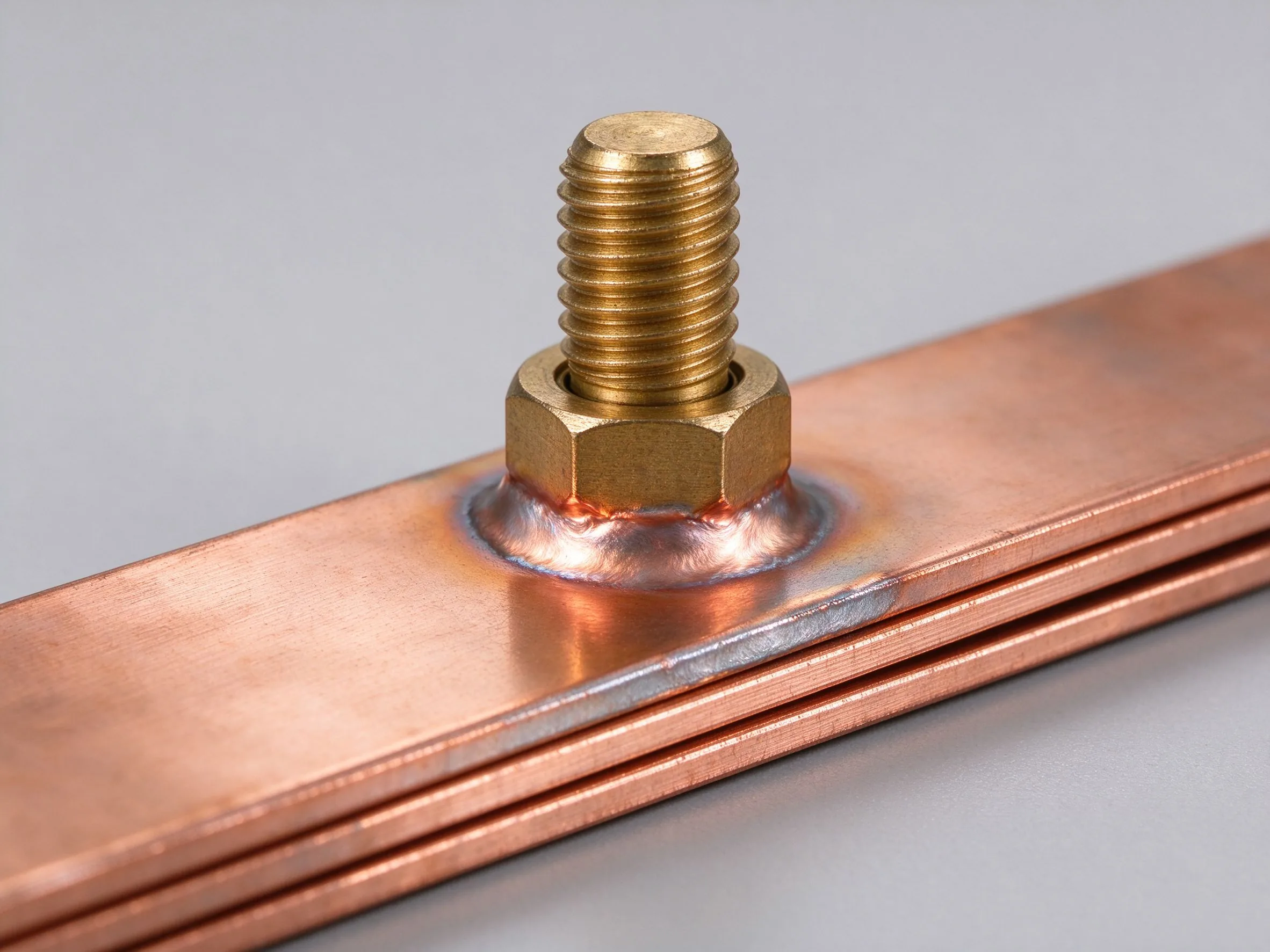
The terminal is where a laminated busbar meets the outside world. This guide covers M6/M8
Read article
A busbar's rating is not a lookup — it is a calculation. Temperature rise is the real limi
Read article
Roughly 40,000 humanoids shipped in China in H1 2026, with full-year output heading past 1
Read article
Lucas Meyer advises procurement and supply-chain teams on copper sourcing, busbar pricing and supplier evaluation, with 13 years in industrial metals and electrical-component procurement. He developed SHANYUAN's copper-price quotation model and cost-breakdown framework for busbar projects. He h
Send the current profile, voltage class and terminal types — our engineers reply within one business day.