Every lead-free tin-plated busbar is a candidate for whisker growth. The filaments are single crystals of tin that extrude from the surface to relieve compressive stress, and they can bridge a 0.5 mm gap at 60 V. The industry has spent two decades learning to control them, and the controls are now well documented. What still goes wrong is the specification: a drawing that says 'tin plated' without naming the process, the underplate or the anneal leaves the supplier free to choose a finish that will grow whiskers in the field.
Every lead-free tin-plated busbar is a candidate for whisker growth. The filaments are single crystals of tin that extrude from the surface to relieve compressive stress, and they can bridge a 0.5 mm gap at 60 V. The industry has spent two decades learning to control them, and the controls are now well documented. What still goes wrong is the specification: a drawing that says 'tin plated' without naming the process, the underplate or the anneal leaves the supplier free to choose a finish that will grow whiskers in the field.
First published 6 November 2026 · Last updated 12 November 2026
A tin whisker is a filamentary single crystal, typically 1–5 µm in diameter and 10–500 µm long, that grows out of a tin or tin-alloy finish without any applied electric field. It is not a dendrite, which grows under bias in the presence of moisture and ionic contamination, and it is not corrosion. It is a mechanical response: the coating is under residual compressive stress, and tin relieves that stress by extruding material at a weak point in the oxide.
The growth can take years. A part that passes inspection at shipment can produce a 200 µm filament after 3,000 thermal cycles or after two years at ambient. That time dependency is why the acceptance question is not 'are there whiskers now' but 'what is the growth rate under the stresses this part will see'.
The growth is not uniform across a surface. Whiskers emerge from a limited number of nucleation sites, often at grain boundaries with a specific orientation or at a scratch, and the same finish can produce none on one part and a dozen on the next. That is why acceptance is expressed as a density per unit area rather than as a count, and why a single part with no whiskers proves very little about a lot.
Four sources dominate in busbars. First, intermetallic compound formation: tin and copper react at room temperature to form Cu6Sn5 at the interface, which occupies more volume than the consumed copper and pushes back into the tin layer. Second, plating process stress: bright tin and high-current-density deposits carry more internal stress than matte tin. Third, mechanical stress: bending, punching, screw thread forming and torquing all impose local deformation that the coating inherits. Fourth, thermal mismatch: copper expands more than tin, so every temperature cycle adds strain.
In a laminated busbar all four are present. The bar is bent, punched and bolted, and it runs warm. That is why a generic 'tin plated' callout on a busbar drawing is a weaker specification than the same callout on a flat connector.
The intermetallic reaction is diffusion-limited, which means it slows as the layer thickens but never stops at room temperature. Over years the Cu6Sn5 layer can consume a large fraction of a thin tin deposit, and the volume change keeps feeding compressive stress into what remains. That is the reason a thin tin over bare copper is a worse combination than the same thickness over nickel: the nickel slows the diffusion that drives the whole mechanism.
Tin-lead plating was the default until the RoHS directive removed lead from most electronics in 2006. Tin was the obvious substitute: solderable, conductive, cheap and compatible with existing plating lines. The whisker problem came with it, and the industry response was a set of process controls and test standards rather than a return to lead.
For busbars the substitution also changed the corrosion story. Tin protects copper sacrificially in most indoor environments, but a thin or porous deposit exposes copper at pores and creates a galvanic couple that accelerates local corrosion. Thickness and porosity therefore matter for both whisker and corrosion performance, and they are specified together.
There is also a historical record that makes the risk concrete. The Galaxy IV communications satellite failed in 1998 because of tin whiskers bridging contacts in a detector, and several later incidents in relays and connectors have been traced to the same mechanism. Those failures involved pure tin finishes with no mitigation, in equipment that was expected to last fifteen years. The lesson was not that tin is unusable, but that an uncontrolled tin finish is a long-term reliability decision made by default.
Nickel underplate. A 1–3 µm nickel barrier between copper and tin blocks interdiffusion. Without it, Cu6Sn5 grows into the tin and the compressive stress keeps rising. With it, the interface reaction is slowed by orders of magnitude. This is the single most effective control for copper substrates.
Matte tin, not bright tin. Matte deposits have larger grains and lower internal stress, and the grain boundaries accommodate strain. Bright tin with organic additives is smoother and prettier and grows whiskers faster.
Annealing. A reflow or bake at 150 °C for one hour, or 105 °C for a longer period, relaxes plating stress and grows the intermetallic layer to a stable thickness before the part enters service. It must be done after plating and before assembly.
Thickness. Thin deposits (< 3 µm) are more prone to pore corrosion and to rapid stress accumulation; thick deposits (> 10 µm) carry more stored stress but also more material to relieve it. Practical range for busbars is 6–12 µm over nickel.
The anneal has a second effect that is easy to miss. Heating the deposit recrystallises the grain structure and, if the temperature is high enough, grows the intermetallic layer to a thickness that is stable at service temperature. The part then enters the field with most of the stress already relieved, and the remaining growth rate is much lower. An anneal done before plating, or skipped because the part will be baked later in assembly, does not have the same effect.
Whiskers preferentially emerge at grain boundaries that have been deformed. In practice that means the outside radius of a bend, the edge of a punched hole, and the crest of a rolled thread. A busbar with ten bends has ten stress concentrators, and a terminal stud has a helical stress field along its whole length.
Design choices reduce the risk without changing the finish: larger bend radius relative to thickness, punched rather than sheared holes, rolled rather than cut threads, and no sharp re-entrant corners. Where geometry cannot change, the finish has to carry the burden: nickel underplate plus anneal, and in extreme cases a selective coating on the thread. Our bend radius guide covers the mechanical side; this article covers the coating side.
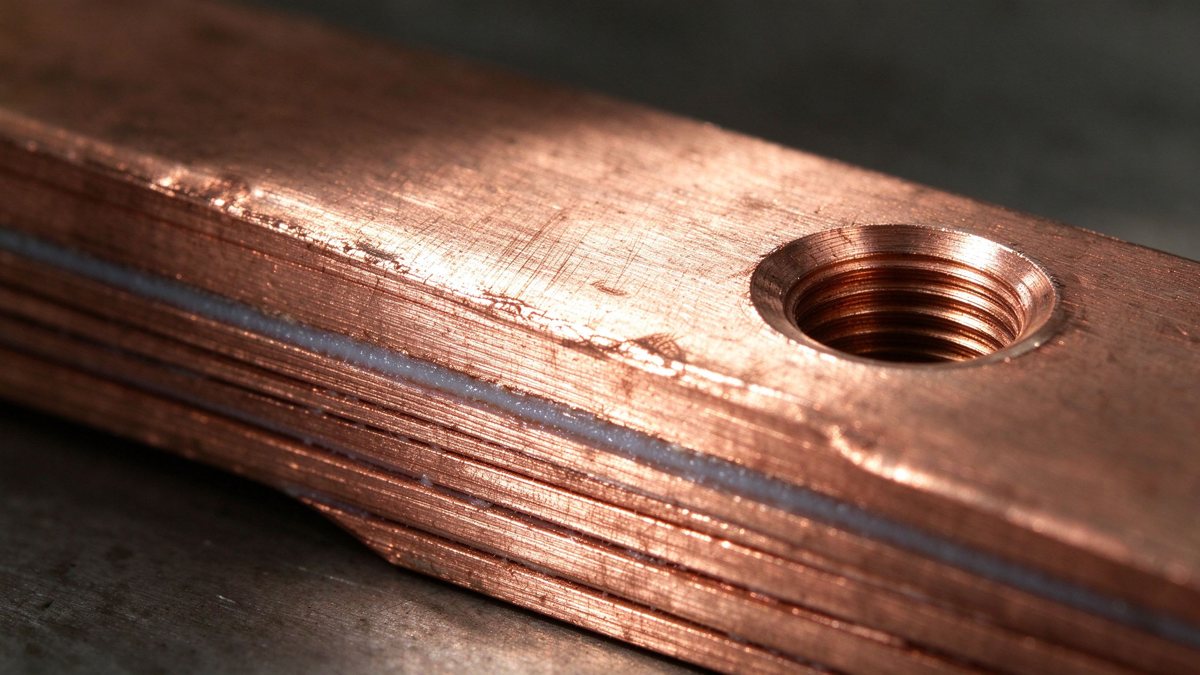
Sheared edges are worse than punched edges for a different reason: the shear creates a burr and a heavily deformed zone that the plating cannot cover uniformly, and the thin deposit at the burr tip is where a whisker most often starts. Deburring before plating, and a minimum plating thickness at the edge, are cheap process controls that are frequently omitted because the edge is not a functional surface.
A busbar in a drive or a switchgear cabinet sees daily temperature swings of 30–60 K. Each cycle imposes differential expansion between copper, nickel and tin. The nickel barrier helps chemically but adds its own interface; the tin still creeps and recrystallises. Laboratory work on lead-free tin finishes consistently shows that thermal cycling is the most effective accelerator of whisker growth, more so than constant high humidity.
JEDEC JESD22-A121 uses 1,000 thermal cycles between −40 °C and +85 °C as one of the standard acceptance regimes. For a busbar that will see 3,000 cycles in service, passing 1,000 is a screen, not a proof. The engineering answer is margin: choose the finish that grows slowly, then verify at the cycle count the application will actually reach.
The acceleration is not linear. Growth follows a diffusion and creep process, so the rate rises faster than the temperature does, and a joint that runs 20 K hotter than its twin will not simply grow whiskers 20% faster. That is one more reason to fix the hot joint found in a thermal survey rather than watching it: the coating degradation is on the same curve.
Moisture does two things. It corrodes the tin oxide and creates new stress sites, and it can transport ions that produce dendritic growth rather than whiskers. In a coastal or condensing environment the two mechanisms overlap, which makes diagnosis difficult: a filament found after a year outdoors may be a whisker, a dendrite, or a corrosion product.
The test distinction matters because the countermeasures differ. Whiskers are solved with underplate, matte finish and anneal. Dendrites are solved with cleanliness, conformal coating and elimination of bias across the surface. If you see growth on a busbar in a humid cabinet, inspect for ionic residue first; if the surface is clean and the growth is single-crystal, treat it as a whisker problem. Our plating and corrosion guide covers the ionic side.
The corrosion products themselves create stress. When tin oxide grows, it occupies more volume than the metal consumed, which pushes on the surrounding deposit exactly as an intermetallic layer does. A humid, slightly contaminated surface therefore accelerates whisker growth even without electrical bias, and a conformal coat that prevents moisture ingress also slows the mechanism.
JESD22-A121 defines the whisker test method: sample preparation, ambient and thermal cycling conditions, and the measurement of length and density. JESD201 defines acceptance classes for components used in different environments, with class limits on whisker length and density after the test. JEDEC also publishes JP-A121 and JP-002 guidance on mitigation. On the assembly side, IEC 61439-1 does not address whiskers directly, but its creepage and clearance requirements are the reason a filament matters: a 200 µm filament can reduce an air gap enough to start a partial discharge.
None of these standards sets a busbar-specific limit. The buyer has to translate the class limit into a drawing requirement, and that translation should reference both the test method and the cycle count. The standards library links the documents.
The acceptance class is the part of the standard that buyers most often leave blank. JESD201 defines classes by the environment the component will see, with tighter limits for long-life, high-reliability equipment and looser limits for short-life consumer products. A busbar in a ten-year drive cabinet belongs in the tighter class, and saying so on the drawing is the only way the supplier knows to test to it.
Visual inspection at 10× magnification finds long filaments on flat surfaces and misses short ones in threads and at bend radii. Scanning electron microscopy finds the short ones but samples a tiny area. The practical routine is a layered approach: 10× visual on all surfaces, 30× on threads and bend radii, SEM on a sample per lot for the first three lots and then per quarter.
For incoming inspection the more useful measurement is plating thickness and underplate presence, because those predict growth better than a snapshot of current filaments. X-ray fluorescence gives thickness in seconds and is non-destructive. Cross-section on a sample confirms the nickel layer.
Where the finish has to hold torque as well as survive corrosion, the hole and thread details in the terminal machining guide matter: a shaved thread removes the very layer the whisker controls depend on.
Sampling frequency is a decision, not a default. The first three production lots of a new finish deserve a full SEM examination, because the plating line is still stabilising. After that, a quarterly sample plus a thickness check per lot is a reasonable compromise between cost and assurance. Any change of plating bath chemistry, current density or annealing furnace resets the cycle.
Indoor sealed cabinet, low voltage: matte tin 8–12 µm over 2 µm nickel, annealed; visual inspection at incoming; no conformal coat. Outdoor or condensing: same finish plus a conformal coat on non-contact surfaces and a sealed terminal interface. High-voltage (> 1 kV) with small air gaps: nickel underplate mandatory, whisker length acceptance tightened, and clearance designed with margin for a 100 µm filament. Threaded studs: rolled threads, selective coat, and a specified torque that does not shave the plating.
The matrix is a starting point. A 400 V drive busbar and a 24 kV switchgear busbar do not carry the same consequence of a filament, so the acceptance class should follow the consequence, not the commodity code.
For outdoor cabinets and industrial drives the same finish is usually specified together with an industrial application enclosure class, and the plating choice should be agreed at the sample-to-series stage rather than at series release.
One combination deserves a warning: bright tin over bare copper with no anneal, on a part that is bent after plating. It is the cheapest finish on the quotation sheet and the fastest to grow whiskers, and it appears most often on low-volume parts where the plating shop uses whatever bath is running. If a quote is materially below the others on a plated part, this is worth asking about directly.
Nickel underplate adds a plating step and a bath to maintain. Annealing adds a furnace cycle and handling. Matte tin is cheaper than bright tin in additive cost but less forgiving in appearance, which matters if the part is customer-visible. In total, the whisker-controlled finish typically adds a few percent to the plating cost and a small amount to lead time, not a multiple of the part price.
The comparison should be against the cost of a field failure, not against the cheapest finish. A whisker-induced short in a drive cabinet takes a service call, a replacement and possibly a customer claim; the plating delta is trivial beside it. Buyers who ask for 'tin plated' and accept the cheapest process are optimising the wrong line of the quote.
The arithmetic of comparing a controlled finish against a cheaper one follows the same five-block logic used for the landed cost per good unit, where a few percent on plating is weighed against field failure exposure.
The cost of changing a finish mid-program is higher than the plating delta suggests. A finish change is a process change, which triggers first-article inspection, dielectric requalification and often a customer notification. The plating cost is a few dollars per part; the change program is weeks of engineering. Specifying the finish correctly at the drawing stage is the cheap path.
A complete callout: substrate copper C11000; nickel underplate 1.5–3 µm; matte tin 6–12 µm; anneal 150 °C for 1 h after plating; whisker test per JESD22-A121 with 1,000 thermal cycles and acceptance per JESD201 class 2 (or the class the application requires); no bright tin or organic brightener; thread and bend surfaces included in inspection; certificate of conformance with thickness measurements per lot.
That is six lines on a drawing and it closes the loophole. The terminal machining guide gives the complementary thread and shoulder requirements so the coating is not damaged at assembly.
Add one line that is often omitted: the acceptance sampling plan. A drawing that says the part shall meet JESD201 class 2 without saying how many parts are tested and at what frequency gives the supplier latitude that the buyer did not intend. State the sample size per lot and the annual audit frequency.
Whiskers are a slow failure mode with a known mechanism and a known set of controls. The parts that fail are almost always those where the finish was specified loosely and the process was chosen by the plating shop for appearance or speed. For a busbar that has to last fifteen years in a warm cabinet, the finish is a reliability decision, not a cosmetic one.
Specify the underplate, the matte finish, the anneal and the test class. Then verify thickness per lot instead of trusting the certificate. If a supplier cannot provide the nickel layer or the anneal, that is information about their process capability, and it belongs in the sourcing decision. Our quality documentation shows the records we hold per plating lot.
The plating on a busbar contact is a corrosion strategy as much as a conductivity play. Ti
Read article
A manufacturing-focused guide to busbar surface plating: electroplated tin, nickel and sil
Read article
Thomas O'Brien is a manufacturing process engineer with 14 years in stamping, lamination and terminal machining for laminated busbars. He manages production lines for precision-cut profiles, insulation layering and CNC terminal processing, and focuses on dimensional control and repeatability at
Send the current profile, voltage class and terminal types — our engineers reply within one business day.