A bolted busbar joint is a corrosion cell waiting to happen: copper oxide is an insulator, moisture and temperature cycles accelerate growth, and the contact resistance drifts upward until the joint overheats. The plating is the strategy against that drift — and the three candidates behave very differently. Tin is soft and deforms under bolt pressure to create real contact area; silver's oxide is conductive, so the interface degrades slowly; nickel's passivating oxide requires high contact force to break through. This guide compares the three for busbar contacts, with thickness ranges, standards and the failure modes that decide the choice.
A bolted busbar joint is a corrosion cell waiting to happen: copper oxide is an insulator, moisture and temperature cycles accelerate growth, and the contact resistance drifts upward until the joint overheats. The plating is the strategy against that drift — and the three candidates behave very differently. Tin is soft and deforms under bolt pressure to create real contact area; silver's oxide is conductive, so the interface degrades slowly; nickel's passivating oxide requires high contact force to break through. This guide compares the three for busbar contacts, with thickness ranges, standards and the failure modes that decide the choice.
A busbar's bulk resistance is set by the copper; its long-term reliability is set by the contact interfaces. At every bolted joint, the real current path is a set of microscopic asperities pressed together under bolt load. Between those asperities, the environment does its work: oxygen, moisture, sulfur and temperature cycles grow oxide films that raise contact resistance, and the resulting heat accelerates the growth.
The function of plating is to replace the copper surface with a metal whose oxide behavior is manageable — either soft enough to deform and expose clean metal (tin), or conductive enough that the oxide doesn't block current (silver), or hard and stable where the application demands wear resistance (nickel).
Tin is the default busbar contact finish for a reason. Bulk conductivity is poor (~15% IACS), but the deposit is thin and the mechanism that matters is mechanical: tin is soft, so under bolt pressure it deforms plastically, breaking surface oxides and creating a large true contact area (GRL Copper, 2026). The oxide that does form (SnO₂) is an insulator, but the soft metal keeps exposing fresh material under load, keeping contact resistance stable.
Thickness is specified per ASTM B545, the standard for electrodeposited tin coatings: published practice for busbar contacts is typically 3–10 µm, with the specification written as a local minimum on contact areas rather than a vague 'standard tin' (Jumai, 2026; A&J Link, 2026).
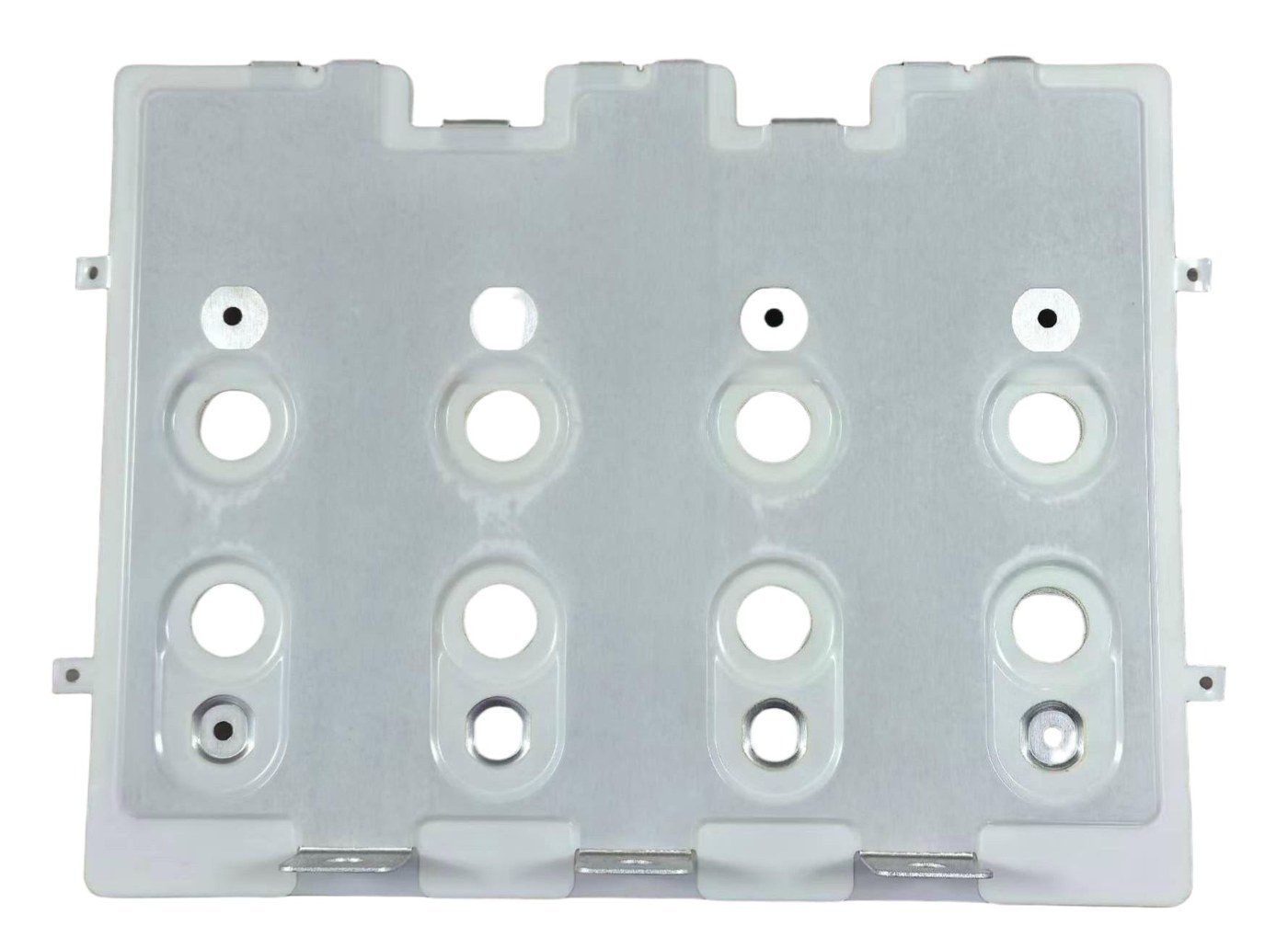
The tin thickness band has real limits. Below the minimum, the deposit is porous, corrosion reaches the copper, and contact resistance rises over time. Above about 10 µm, the preload stability degrades — a thick soft coating cold-flows under sustained bolt load, reducing the retained contact pressure (A&J Link, 2026). The engineering answer is a specified range (e.g., 5–10 µm on contact areas), verified per ASTM B545 by X-ray fluorescence or cross-section on qualification parts, and the same discipline the fabrication tolerances guide applies to dimensions.
Adhesion is the second requirement: plating that lifts or blisters at the interface defeats the strategy. ASTM adhesion tests and lot control are part of our quality system.
Pure matte tin grows whiskers — conductive filaments that can bridge clearances — at all temperatures; alloy additions (Sn-Cu, Sn-Bi, Sn-Ni) mitigate the risk (MakerStage, 2026). For busbar contacts the practical concerns are different from fine-pitch electronics: clearances are large and the whisker risk to function is lower, but the mitigation still applies where the specification demands it — bright or alloyed tin, or reflowed deposits, per customer requirement.
The operating temperature ceiling for tin deposits is around 150°C continuous; above that, the coating degrades and silver or nickel should be considered (MakerStage, 2026).
Silver is the premium contact finish. It has the highest electrical and thermal conductivity of any metal (~105% IACS) and, uniquely, its oxide is electrically conductive — so even after the surface oxidizes, the interface does not degrade the way tin and nickel interfaces do (GRL Copper, 2026). Contact resistance for silver-plated high-current terminals is typically 0.1–1 mΩ (or 3–10 µΩ at busbar scale), versus 10–30 µΩ for tin (GRL ESS data, 2026).
Typical silver plating for automotive and high-current terminals ranges from 3–10 µm (TONFUL, 2026). The penalty: silver is sulfur-sensitive — silver sulfide tarnishes in industrial and coastal atmospheres — and costs more. Where the environment is controlled (sealed converter housings, traction modules) and the current density is high, silver earns its premium; where the joint is in a dusty utility environment, tin's mechanical behavior may serve better.
Nickel is chosen for hardness and wear resistance (frequent mating, sliding contacts) and as an underlayer, but as a final contact finish it has a fundamental drawback: it forms a tenacious, passive oxide that requires high contact force to break through, and the interface resistance stays high if the force isn't there (GRL Copper, 2026). For bolted busbar joints where the load is controlled by torque, nickel as a final layer is generally avoided; nickel-under-silver or nickel-under-tin combinations use its hardness without its contact penalty.
The decision matrix for our customers: wear and repeated mating favors nickel-bearing stacks; long-term contact stability favors tin or silver topcoats.
Field corrosion at busbar joints follows a few recurring modes: galvanic corrosion where dissimilar metals meet (aluminum-to-copper joints with improper transition hardware, covered in our aluminum vs copper article); atmospheric tarnish (sulfide on silver, oxide on copper); fretting corrosion at micro-motion interfaces where vibration and thermal cycling grind the contact; and moisture-driven galvanic action at partially sealed joints.
Each mode has a plating answer: proper transition plating and hardware for dissimilar joints, sealed or greased interfaces for moisture, and alloyed or harder deposits where fretting dominates.
Thermal cycling makes busbar joints breathe: differential expansion between copper, plating and hardware produces micro-motion at the contact, and the repeated scrub grinds the surface — fretting. The debris oxidizes, the contact resistance climbs, the joint runs hotter, and the cycle accelerates. The thermal management guide and the short-circuit withstand guide (published today) both touch the mechanical side; the plating answer to fretting is a deposit that keeps a clean interface under motion — tin's softness helps, silver's conductive oxide helps, and proper torque and hardware (Belleville washers, controlled expansion) reduce the motion itself.
Plating choice interacts with the operating temperature. Tin deposits are rated to roughly 150°C continuous before oxidation and creep accelerate; silver extends the useful range substantially (contact interfaces in traction and aerospace run hotter); nickel-bearing stacks handle the highest temperatures but carry the contact-force penalty. The junction of temperature and plating is where the contact budget meets the temperature-rise calculation: a joint running at 105–130°C under IEC 61439 limits is a different plating decision from one capped at 65 K rise.
A plating spec that survives field service reads like: 'Tin plating per ASTM B545, 5–10 µm local minimum on contact areas, matte or reflowed; adhesion per ASTM B571; verified by XRF on first article and defined lot intervals.' For silver: 'Silver plating 5–10 µm over 1–3 µm nickel underlayer on contact areas, tarnish-resistant finish where specified.' For nickel-bearing stacks, the underlayer thickness and the topcoat are specified separately.
The point is precision: 'tin plated' on a drawing produces a range of outcomes; '5–10 µm per ASTM B545 on contact areas' produces a joint that survives decades.
For laminated busbars, plating interacts with manufacturing: the tin (or silver) surfaces that will become bolted contacts must stay clean through lamination — masking, registration and handling all matter, because contamination between laminate and contact defeats the plating. The manufacturing process article covers the lamination sequence; the materials team's plating schedule is integrated into it so the contact areas ship exactly as specified.
With copper at record prices in 2026 (see our copper supply analysis), the incremental cost of plating choice matters more: silver adds precious-metal cost at every ampere; tin is inexpensive; nickel sits between. The 2026 industry comparison for ESS busbars (GRL, September 2026) frames it as: tin wins on cost and indoor performance, silver wins on conductivity and sulfur-free environments, and the decision is contextual rather than absolute. For the volumes of 2026 storage and solar build-out (covered in our storage market article), the plating decision is now a line item in the BOM, not a footnote.
Verification of a plated joint: contact resistance measurement across the interface at defined torque (milliohm-level, per the terminal connection guide), thermal-cycling tests that reproduce the fretting regime, and — for qualification — temperature-rise tests on the assembled joint. Plating thickness, adhesion and porosity are the material-side checks; torque, surface condition and hardware are the assembly-side checks. Both belong in the incoming inspection and the production record.
The recurring plating mistakes: unspecified thickness ('tin plated') that ships at 1 µm and corrodes in a year; silver in a sulfur-rich environment without sealing; nickel as a final finish on a torque-controlled bolted joint; plating contaminated during lamination; and torque applied before the soft coating settles, losing preload over thermal cycles. Each has a measurable field cost — contact resistance drift, hot joints, field re-torque campaigns — and each is preventable at specification time.
The plating on a busbar contact is a decades-long corrosion strategy written in a few microns of metal. Tin for the workhorse joint — soft, self-healing, inexpensive, ASTM B545-specified. Silver where current density and oxide behavior demand it — conductive oxide, higher cost, sulfur-conscious. Nickel as an underlayer and wear answer, rarely as a final contact finish. The thickness ranges, the standards and the failure modes are all known; the engineering is in applying them per application and environment.
Our materials engineers specify the plating schedule on every custom busbar with the joint conditions and environment in the loop — and the quality record ships the verification with the part.
Parallel busbars are supposed to share current equally — physics disagrees. Skin effect pu
Read article
Global energy storage additions are forecast at 158 GW in 2026, up 45% year-on-year, with
Read article
A short circuit is the busbar's worst moment: tens of kiloamps peak, forces in kilonewtons
Read articleSend the current profile, voltage class and terminal types — our engineers reply within one business day.