Port electrification has moved from pilot to procurement. Battery-electric ferries now charge in berth in under 15 minutes; harbour tugs and cruise ships plug into shore power to cut diesel burn while docked. The hardware chain underneath these systems — shore converter, DC link, battery bank, vessel-side charger — depends on laminated busbars that were rarely specified in marine power five years ago.
Port electrification has moved from pilot to procurement. Battery-electric ferries now charge in berth in under 15 minutes; harbour tugs and cruise ships plug into shore power to cut diesel burn while docked. The hardware chain underneath these systems — shore converter, DC link, battery bank, vessel-side charger — depends on laminated busbars that were rarely specified in marine power five years ago.
Three market trackers tell the same story. The global shore charging systems market was valued at USD 450 million in 2025 and is projected to reach USD 1,200 million by 2034, a CAGR of 11.5% (Statsmarketresearch, 2026). The broader shore-to-ship power supply market is forecast to expand from USD 2.29 billion in 2025 to approximately USD 4.41 billion by 2035, a CAGR of 6.78% (GlobeNewswire, 2026). Ship fast charging systems — the segment that matters most to battery-electric vessels — is set to grow from USD 150 million (2025) to USD 350 million (2034) at a CAGR of 10.0%.
Low-voltage shore connection still holds 32.1% of the 2025 installation market at USD 531.19 million, because it is the cheapest way to retrofit smaller ships and older fleets (PW Consulting, 2026). High-voltage and DC systems take the rest — and they are the ones that pull busbar content per installation.
Ferry operators want three things from a berth: fast turnaround, zero local emissions, and no megawatt-scale diesel generators idling at the dock. AC shore power supplies the vessel directly, but charging a battery-electric ferry requires controlled DC. The shore system therefore becomes a converter station: grid AC in, regulated DC out to the ship's battery bus.
DC shore power also pairs naturally with onboard storage, shore-side battery buffers and solar at the port. Each of those paths terminates in a DC bus — and the higher the current, the stronger the case for laminated rather than cabled connections.
A typical 1-3 MW shore charging cabinet contains: an MV/LV transformer, an AC/DC converter stage, a DC link with film capacitors, and one or more charging outlets to the vessel. Between the capacitor bank and the converter modules, a laminated DC-link busbar carries several thousand amps in a compact footprint.
On the vessel side, a battery-electric ferry stores 5-20 MWh and charges at 1-4 MW. The charging interface, battery contactor box and main battery bus all use copper busbars sized for fast-charging duty cycles rather than continuous berth power.
Shore converters switch at 2-10 kHz. At those frequencies, stray inductance in the DC link converts to voltage overshoot on every switching event, so the busbar between capacitor and IGBT/SiC modules must be a low-inductance laminated stack, exactly as in traction converters.
The busbar also has to handle the fault case: a short at the charging outlet can push tens of kiloamps through the link until the breaker opens. Mechanical rigidity, bolted terminations and plating that survives salt air are therefore specified alongside electrical ratings.
Shore power splits into two voltage families. Low-voltage shore connection (LVS) typically runs 400-690 VAC and 750-1000 VDC. High-voltage shore connection (HVS) uses 6.6 kV or 11 kV AC at the interface — but the converter and battery side of those systems still works at 1000-1500 VDC.
For a busbar supplier, the practical consequence is that DC-link and battery busbars for marine systems sit in the 1000-1500 V insulation coordination class, needing PET or Nomex dielectrics, edge sealing and creepage distances per IEC 60664-1 with the DC factor applied.
A berth-side cabinet lives metres from seawater. Copper oxidises fast in that environment, so terminations are typically tin-plated for maintenance-free contact, with silver specified only where skin-depth loss at high frequency matters. Enclosures get marine-grade paint; busbar insulation must be edge-sealed so salt-laden air cannot creep between copper and dielectric.
Our standard production route — C11000 copper, tin plating, PET or Nomex insulation, full edge sealing — maps directly onto marine requirements, and we add humidity-cycled hipot testing for port projects.
Ship fast charging systems are the fastest-growing slice of the market (USD 150M → USD 350M by 2034). The duty is severe: a ferry arrives, plugs in, pulls 1-4 MW for 8-15 minutes, and departs. That is a high-C-rate charge for the battery and a high-cycling-load for every busbar in the path.
Fast-charging busbars are sized on peak current and thermal cycling, not average load — the same discipline as megawatt truck charging on land, but with an added marine environment layer.
At 1000 VDC and 1500 A, a cable run needs large parallel conductors, heavy lugs and significant bending radius. A laminated busbar carries the same current in a fraction of the volume, with predictable impedance and lower installation labour.
Inverter-to-cabinet runs still use cable, but inside the cabinet — converter to capacitor, capacitor to outlet, battery to contactor — busbars win on density, inductance and thermal management.
Marine shore power equipment is referenced against IEC/ISO/IEEE 80005-1 (HV shore connection), IEC 62613 (plug/socket systems) and class-society rules from DNV, Lloyd's Register and CCS. Busbar suppliers to the segment typically support their customers with insulation coordination per IEC 60664-1 and partial-discharge data for medium-voltage interfaces.
Global port electrification budgets are being announced in multi-year waves: EU TEN-T funding, US EPA port grants, and Chinese port greening programs all include shore power and charging infrastructure. The advanced marine power supply market is projected to grow from USD 13.1 billion (2026) to USD 15.7 billion (2031) at 3.7% CAGR (Knowledge Sourcing, 2026).
For component suppliers, the actionable signal is that shore power moved from pilot projects to repeatable procurement — which is exactly when busbar designs become standardised and volume orders begin.
If your company builds shore converters, charging cabinets or vessel-side power systems, the busbar conversation now includes: 1000-1500 VDC insulation class, low-inductance laminated DC links, tin plating with marine-grade edge sealing, peak-current sizing for fast-charging duty, and lot-level test documentation.
SHANYUAN produces laminated busbars for marine and port systems up to about 1000 A per stack, with custom geometries for converter, battery and charging interfaces — and quotes from drawings within one working day.
There is also a purchasing-cycle effect: when ports tender shore power in framework lots, the busbar requirement becomes predictable. A port electrifying ten berths needs ten converter cabinets, and the spare-parts policy usually demands identical busbar geometry across the fleet — which is exactly the standardisation that drives cost down.
A 1 MW ferry fast-charging pedestal we support routes power as follows: shore converter DC link (1000 VDC, ~1100 A) → outlet contactor → cable to vessel → vessel battery bus. The converter-side busbar is a four-layer laminated stack with tin-plated M8 studs; the vessel-side bus uses thicker flat bars with bolted joints designed for the vibration of repeated docking.
Both were sized on the 15-minute fast-charge duty with 30 °C temperature-rise targets, and both ship with 100% hipot, insulation-resistance and continuity test records.
For the buyer, the practical rule is to specify the marine environment in the RFQ: salt exposure class, humidity profile and the vibration levels from nearby cranes and road traffic. A busbar designed for a benign factory cabinet will not survive ten years at a berth, and the difference is visible in the plating and sealing specification, not in the ampacity table.
As battery capacity per vessel grows, berth charging power will follow: 3 MW is becoming common for large ferries, and the next generation of cruise-ship shore power will demand per-berth capacities in the 6-10 MW range. Every watt of that is DC at some point in the chain.
Busbar content per shore power installation is therefore structurally increasing — from LV retrofit cabinets to HV DC links — and suppliers with marine-qualified plating, sealing and testing processes will capture the segment.
One more consideration belongs in the RFQ: the vessel-side plug-and-socket standard. IEC 62613 and related marine plug systems define the interface, and the busbar behind the socket must match the plug's voltage, current and protection class. Design the busbar and the interface together, not sequentially.
Burning marine fuel at the dock is expensive: auxiliary generators run at part load, and port-area emission rules increasingly cap or price those hours. Shore power replaces the generator with grid power, and for battery-electric vessels it is not optional — the battery must be charged from the berth.
Operators compare three numbers when deciding: shore power connection fee versus fuel cost per hour, the capex of the shore-side converter, and the time value of a faster turnaround. Every one of those decisions ends in a charging current that has to cross a DC link.
The practical takeaway for component buyers: the economics of shore power are improving faster than the market forecasts suggest, because fuel prices and port emission fees move up while converter costs move down.
Ports that electrify multiple berths create a significant new load: several megawatts of charging demand arriving in bursts. Port operators are therefore adding shore-side battery buffers and solar canopies, turning the port into a microgrid.
Those buffers introduce another layer of DC hardware — battery racks, bidirectional converters and their DC links. Each layer repeats the same busbar pattern: converter to capacitor bank, capacitor to battery, battery to vessel interface.
For suppliers, the message is that port electrification is a systems build-out, not a single product sale. Busbar designs that can be reused across berth chargers, battery buffers and solar inverters capture the most value.
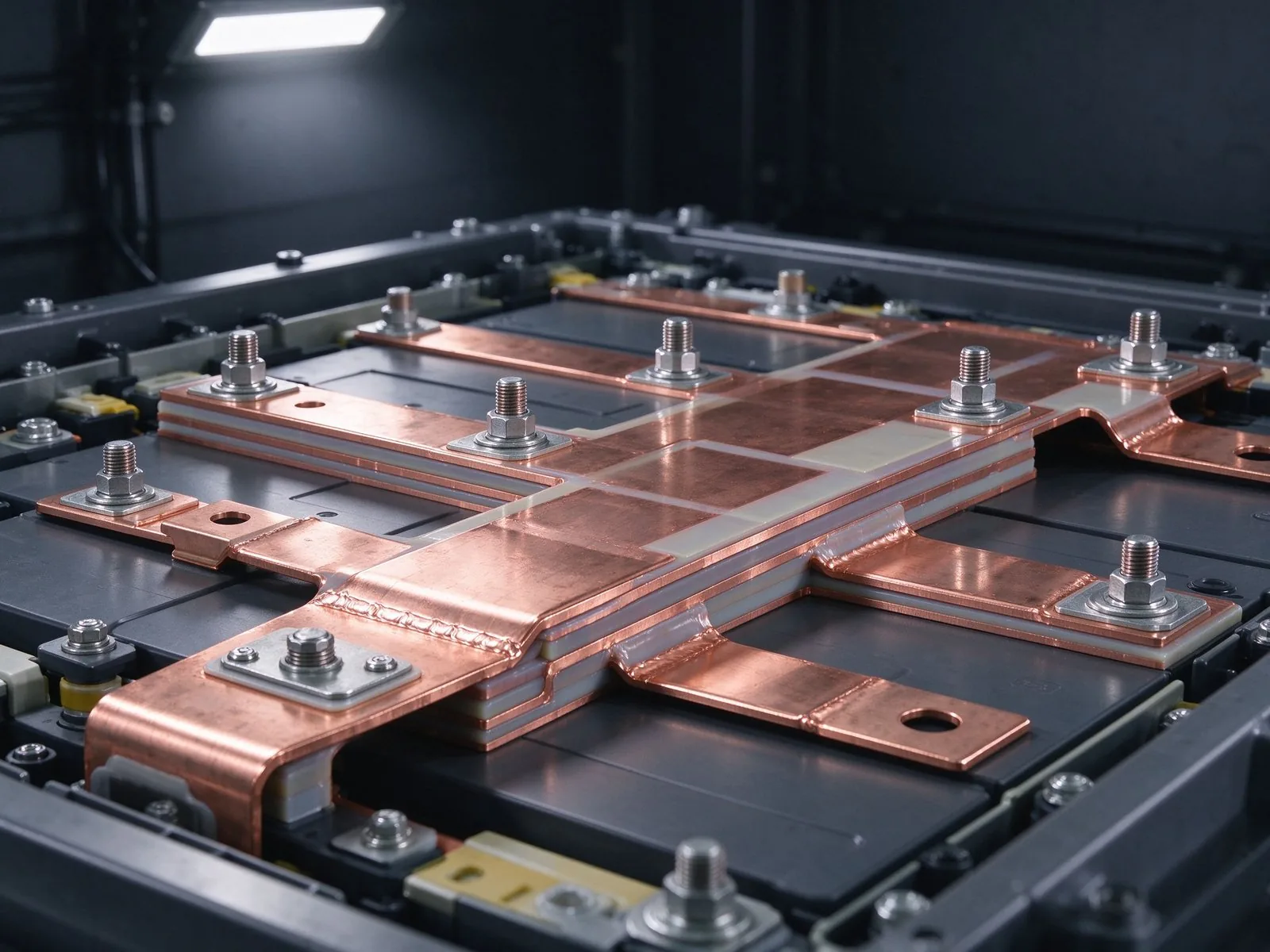
BYD's Megawatt Flash-Charging 2.0 pushes 1.5 MW through a single gun at 1000 V and 1500 A,
Read article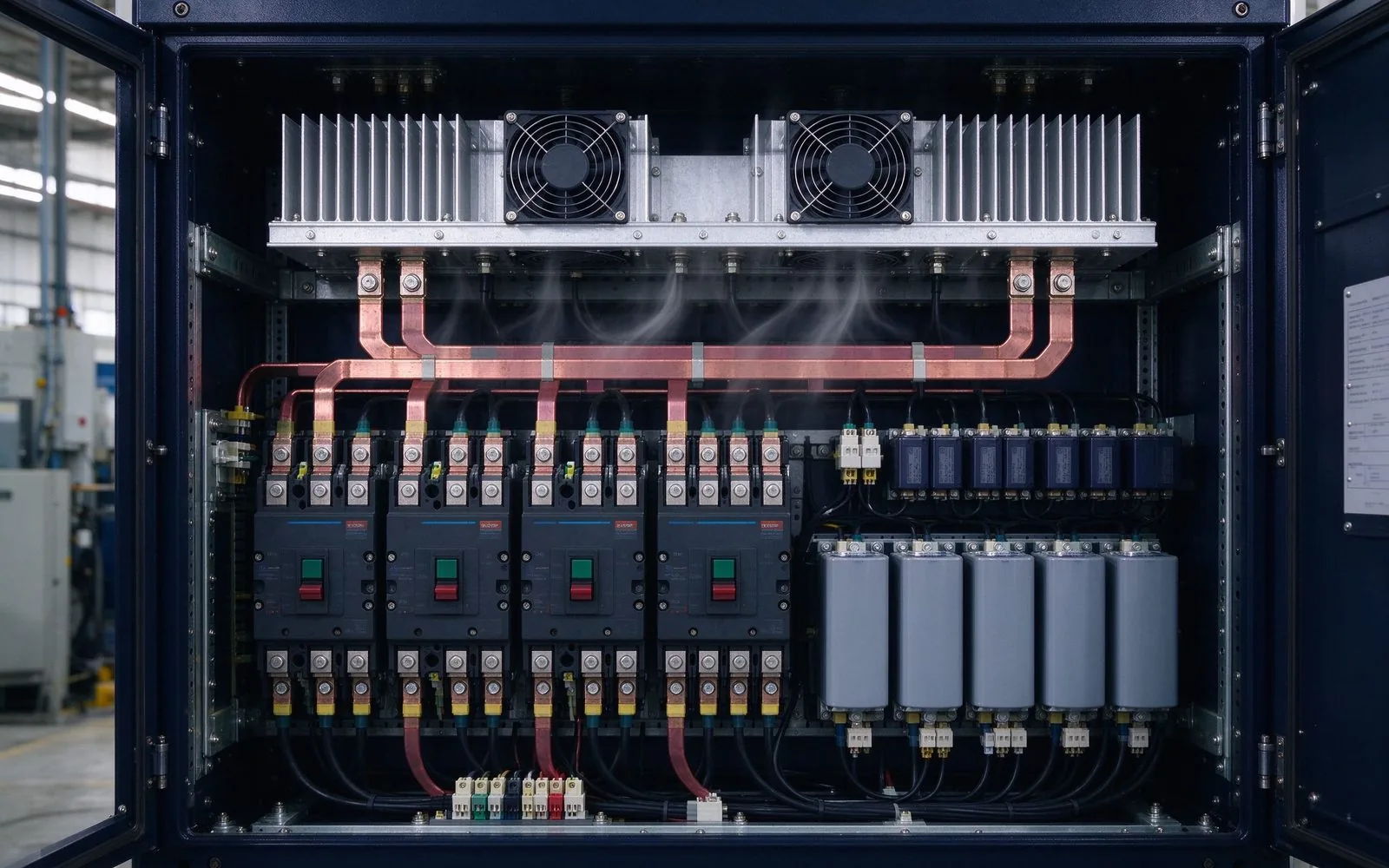
A busbar's thermal design decides its real current rating. Natural convection sheds ~50 W/
Read article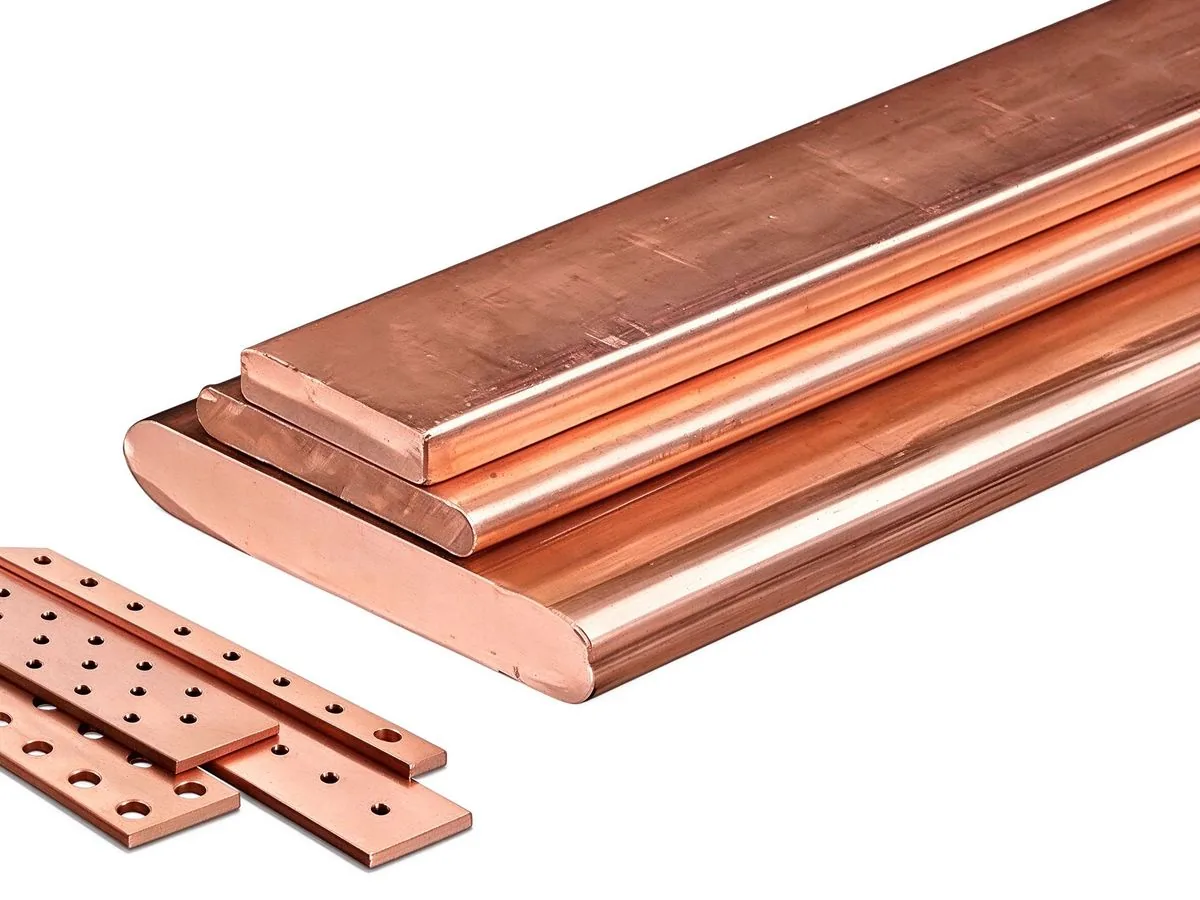
MCS moves from pilot to fleet scale in 2026: 1 MW+ charging at 1250 V and up to 3000 A mak
Read article
Emily Novak analyses energy-storage, grid and new-energy markets and turns them into procurement-ready technical content. With 7 years in energy market research and technical writing, she covers BESS growth, HVDC projects and regulatory shifts that change busbar demand. She holds an M.A. in Energy E
Send the current profile, voltage class and terminal types — our engineers reply within one business day.