Green hydrogen has moved from pilot scale to construction pipeline. Electrolyzer projects now order power supplies the way data centres order switchgear - in megawatts - and every one of those megawatts arrives at the cell stack as low-voltage, very-high-current DC. That current path, from the rectifier output to the electrolyser's cell stack terminals, is where a laminated busbar stops being a commodity and becomes a design decision.
Green hydrogen has moved from pilot scale to construction pipeline. Electrolyzer projects now order power supplies the way data centres order switchgear - in megawatts - and every one of those megawatts arrives at the cell stack as low-voltage, very-high-current DC. That current path, from the rectifier output to the electrolyser's cell stack terminals, is where a laminated busbar stops being a commodity and becomes a design decision.
The market data tells the same story from every angle. PW Consulting estimates the global hydrogen electrolysis power supply market at USD 3,288.94 million in 2026, up from USD 2,480.0 million in 2025 and heading toward USD 5,292.81 million by 2028 (PW Consulting Chemical & Energy Research Center, 2026). Its DC hydrogen generation power supply segment is projected to reach USD 15.92 billion by 2032 at a 35.98% CAGR, with Asia Pacific as the largest regional market (PW Consulting, 2026). IndexBox's baseline for the electrolyzer power supplies market points to a 12.0% CAGR over 2026-2035 (H2Invest, October 2026). In China, the China Hydrogen Alliance expects 1.85 GW of new water-electrolysis capacity in 2026, corresponding to roughly USD 62-68 million of IGBT rectifier power-supply demand (China Hydrogen Alliance data, reported April 2026).
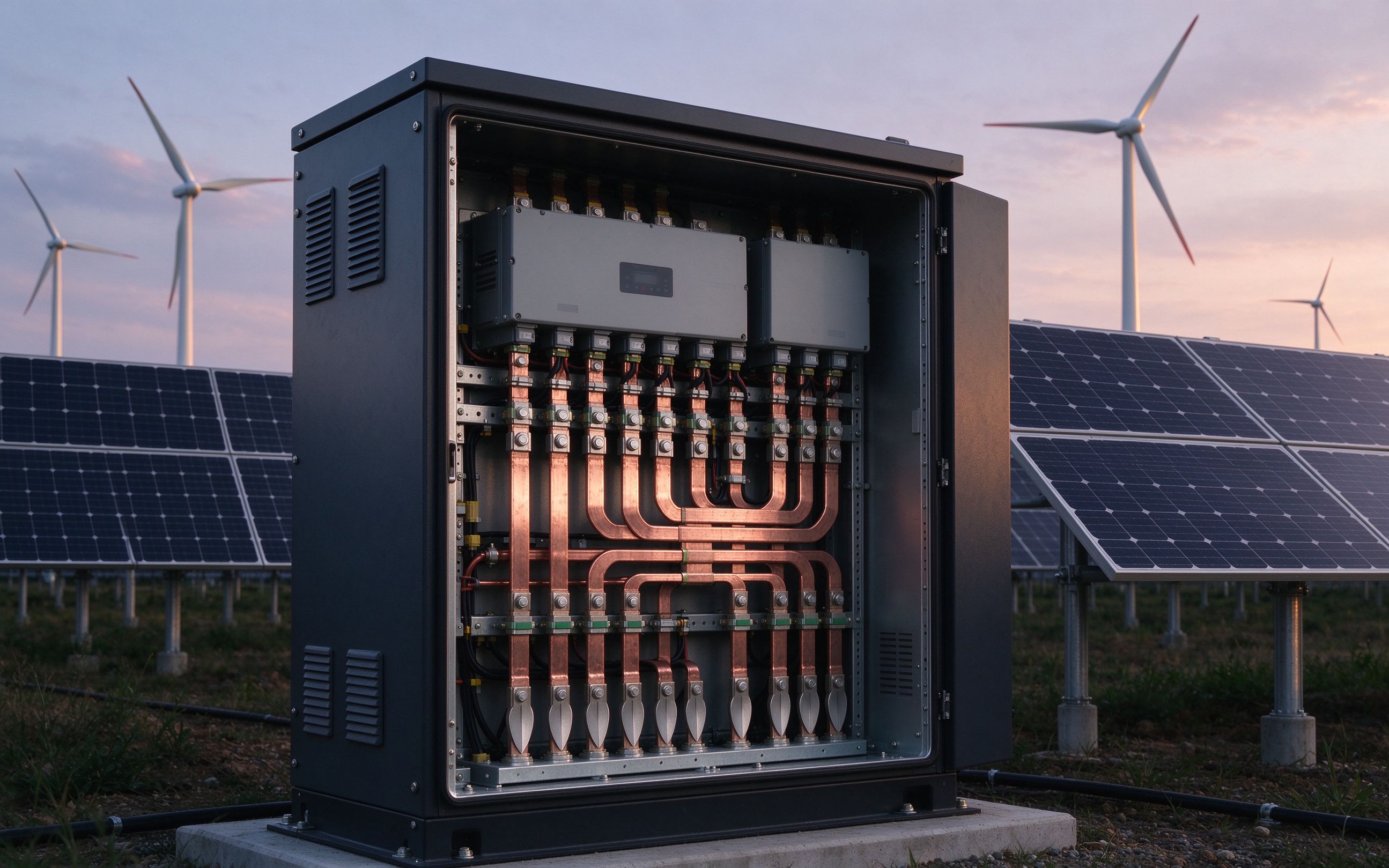
What those numbers mean for a busbar manufacturer is simple: every gigawatt of electrolysis needs thousands of amperes delivered into a low-voltage cell stack. The interconnection between the power conversion system and the stack is not a cable run anymore - it is an engineered DC bus.
An alkaline or PEM electrolyser is fed by a rectifier (thyristor, or increasingly IGBT-based PWM) that converts grid AC into DC at voltages from roughly 100 V to 1,500 V, at currents from 2 kA up to 20 kA or more on large systems. Between the rectifier and the cell stack sit the DC bus, fusing and disconnect hardware, and the stack's own terminal posts.
The bus carries continuous current, not pulses. But it must also handle the transient behaviour of a rectifier turning on and the di/dt of short-circuit events. Inductance in the DC path increases commutation losses in thyristor bridges and, in PWM topologies, produces voltage overshoot that stresses the semiconductors and the stack's electrical insulation. For the same reason, the DC bus in a large electrolyser deserves the same low-inductance design discipline as a traction inverter - just at five times the current.
At 10 kA, an aluminium or copper bar is no longer a small part. A solid copper bar sized for 10 kA at a 30 K rise needs a substantial cross-section, and a single thick bar has three problems. First, its surface area per ampere is poor, so thermal performance is worse than a stack of thinner plates. Second, skin and proximity effects at the switching frequencies of PWM rectifiers crowd current onto the surface, wasting the centre of the bar. Third, a single conductor defines one loop geometry, and stray inductance is set by that loop.
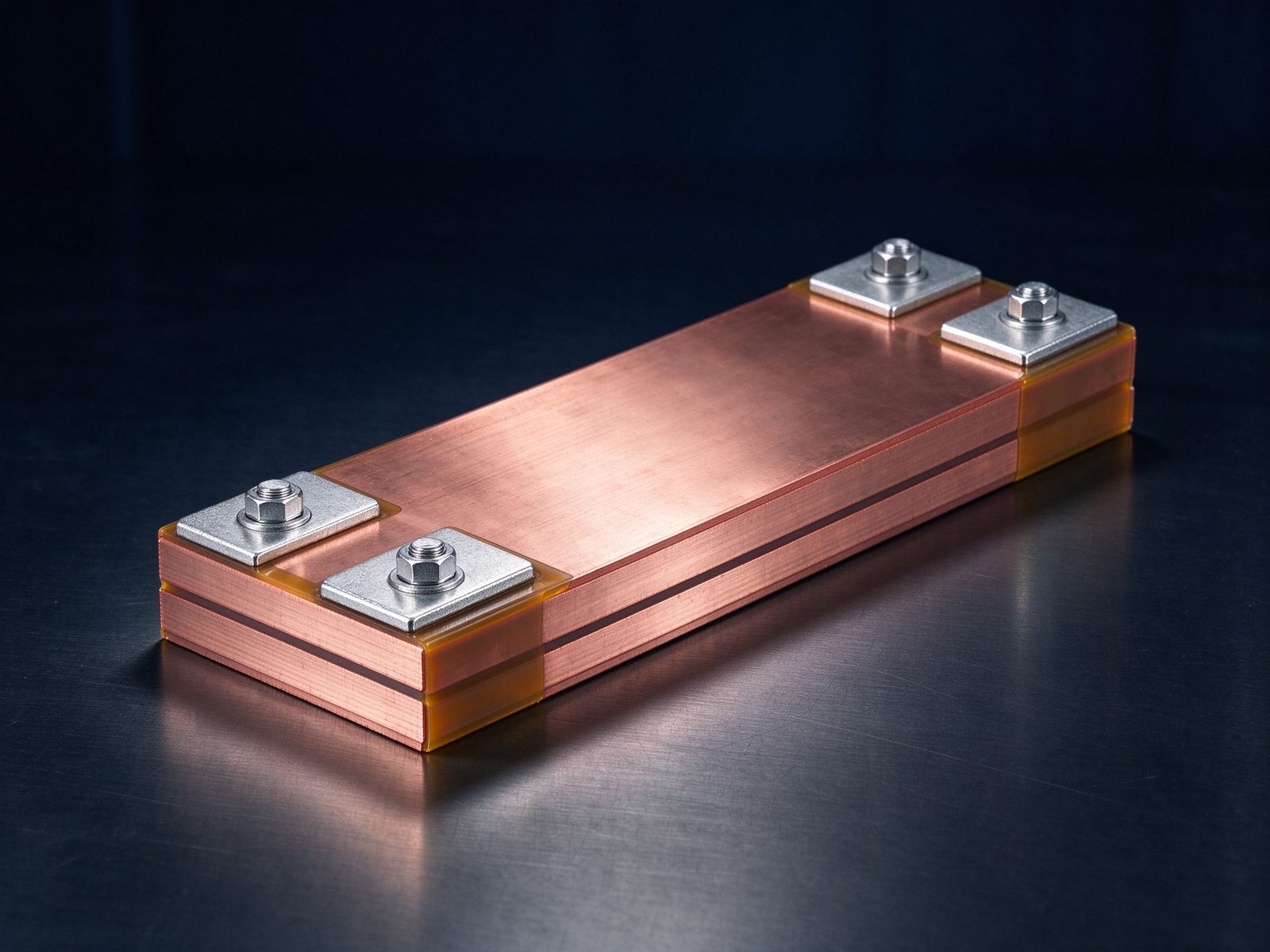
Laminated construction answers all three. Multiple copper layers separated by thin dielectric film multiply the cooling surface, keep each layer thin relative to skin depth, and cancel loop inductance because the forward and return currents run in parallel, closely spaced planes rather than in a large loop. That is why large electrolyser programs increasingly specify laminated DC busbars for the rectifier-to-stack connection - and why the DC-link design discipline carries over directly to the traction converter DC-link world, where the same low-inductance rules apply at 1.5-3 kV.
The ripple current content is worth one more sentence. An IGBT PWM rectifier at 3 kHz puts a ripple band on the bus that the stack and the busbar share; the ripple RMS is typically 10-30% of the DC current, and the busbar loss from ripple is the product of that RMS and the AC resistance at the ripple frequency. In a laminated stack the ripple loss is small because the layers are thin; in a single thick bar it is measurable and continuous, which is exactly the kind of loss that disappears from an efficiency model that only counts DC. The plant's 24/7 operation makes even a kilowatt of continuous loss a lifetime energy item, so the harmonic treatment belongs in the quotation document rather than in the fine print.
The engineering case for a laminated stack in a kiloamp DC path is measurable. Loop inductance drops by an order of magnitude compared with a conventional two-bar layout, which cuts commutation voltage spikes and lets PWM rectifiers switch faster and cooler. Current sharing between parallel layers and parallel rectifier sections becomes a geometry property rather than a field-adjustment exercise, because the layer pattern is fixed at design time. And the rigid, bonded assembly survives the vibration of skid-mounted electrolyser packages, which see continuous low-frequency mechanical excitation from pumps and compressors.
For the operator, the same properties translate into uptime: fewer bolted field joints (each one a potential hot spot), repeatable thermal performance unit to unit, and a documented current rating that supports the project's FAT and commissioning paperwork. The trade-off is that a laminated stack is a custom part - it has to be sized to the exact voltage class, current and terminal layout of the project.
Busbar sizing starts with the temperature rise budget. SHANYUAN's standard design envelope uses a 30 °C rise over ambient as the working limit, matching the common rating convention in IEC 61439-type practice. For a given rise, the required copper cross-section is set by the continuous current and the heat dissipation surface. A single 12 mm-thick bar loses the race against a laminated stack of four 3 mm layers with the same copper mass, because the stack exposes roughly double the surface to cooling air.
Derating in an enclosure is the second input. A rectifier cabinet with restricted airflow may require 70-85% of the free-air rating; a skid with forced ventilation can work at the full figure. The design should therefore be frozen against the enclosure and ventilation data, not against a generic catalogue number. Our busbar ampacity chart gives cross-section-by-cross-section numbers and derating guidance.
Large electrolyser power supplies are built from parallel rectifier sections, each contributing a share of the total DC current. Uneven sharing between sections shows up as one section running hot and another idling, which is both inefficient and dangerous over the project's 20-year design life. The busbar layout is a major determinant of sharing quality.
Symmetric geometry - equal conductor length, equal layer allocation and mirrored terminal positions from the positive to the negative rail - forces equal partial inductance per path, and with it near-equal current distribution. Asymmetry shows up first at high di/dt events, which is why the layout must be checked in simulation, not by eye. Our engineering team documents the sharing analysis with the quotation for every parallel-rectifier program.
Electrolyzer DC buses operate at a broad range of voltage classes. Small PEM systems sit near 100-200 V; large alkaline stacks and pressurised systems reach 600-1,500 V. At 1,500 V DC, creepage and clearance distances are not a footnote. The dielectric between laminated layers must hold the full bus voltage plus transient margin, and the edge sealing of the stack must prevent creepage along the laminate edge in the humid, hydrogen-plant environment.
SHANYUAN builds the stack dielectric in PET, Nomex or epoxy DLF depending on voltage class and temperature, with terminal plating of tin, silver or nickel selected for the connection environment. For the full selection logic, the laminated busbar design guide walks through dielectric and creepage rules in detail.
At 10 kA the I2R losses in even a well-sized busbar are tens of kilowatts. How that heat leaves the bus decides whether the rectifier cabinet needs fans, a cold plate or a water loop. Laminated stacks couple to a cold plate or enclosure across a large flat area, so forced-air and liquid-cooled mounting are both straightforward - the flat laminate face is the thermal interface.
On skid-mounted electrolyser packages, liquid cooling of the DC bus is increasingly specified because the skid already has cooling infrastructure for the power electronics. The busbar can be delivered with an integrated cold plate, sealing the thermal path at design time rather than leaving it to field assembly. Thermal imaging during FAT verifies the rise at full current, and the report ships with the equipment.
The China Hydrogen Alliance expects 1.85 GW of new water-electrolysis capacity in 2026, with IGBT rectifier power supply demand estimated at USD 62-68 million (China Hydrogen Alliance, 2026). Chinese electrolyser OEMs are scaling to multi-hundred-MW projects, which multiplies the size of individual DC buses. A 100 MW alkaline plant at 700 V runs over 140 kA of total DC - delivered through multiple 20 kA buses, each one an engineered laminated stack.
The supply chain consequence: electrolyser OEMs are qualifying busbar suppliers the way traction OEMs do, with FAT, inspection records and documented temperature-rise testing. Factory-direct suppliers with an engineering desk fit this procurement style far better than catalogue vendors.
The electrical design of electrolyser power supplies follows IEC 62477 (power electronic converter systems) and, for hydrogen-specific safety, the relevant hydrogen plant standards and national codes in the project country. Busbar insulation and creepage are typically specified against IEC 61439 or the converter standard referenced by the project specification. Whatever the standard set, the verification chain is the same: insulation test, dielectric withstand, temperature rise at rated current, and inspection of plated contact faces.
SHANYUAN supports this chain with bilingual documentation and inspection records on every batch, which matters for export programs where the FAT is witnessed by the EPC contractor rather than the OEM.
Seven inputs define a hydrogen DC busbar: continuous current (kA); bus voltage class and transient peak; rise budget (typically 30 K); ambient temperature and enclosure ventilation; terminal type (M6/M8 studs, blade or welded tabs) and pitch; dielectric and creepage requirements; and vibration environment if skid-mounted. Send these to the engineering desk and the sizing calculation, layout drawing and quotation come back together.
For a worked example of the trade-offs between conductor materials, the copper vs aluminium comparison shows where each metal wins in kiloamp service.
SHANYUAN builds custom laminated busbars from 1 to 6+ layers, rated to approximately 1000 A per stack at a 30 °C rise, on C11000 ETP copper or aluminium, with PET, Nomex or DLF dielectric and tin, silver or nickel plating. For electrolyser programs the same engineering discipline scales to parallel stacks per 10-20 kA bus section. We document the calculation, build to the drawing, and ship with inspection records and bilingual support - send your specs and the sizing comes back with the quotation. See our custom laminated busbars page or the renewables application page for the surrounding context.
A thyristor rectifier and an IGBT PWM rectifier put very different harmonic loads on the DC bus. Thyristor bridges produce characteristic harmonics at multiples of the line frequency, with ripple that the bus must carry without excessive loss; PWM rectifiers switch at 2-10 kHz and push their sidebands into the bus as well. In both cases the busbar's AC resistance at the relevant harmonic frequencies adds real loss on top of the DC figure.
The practical treatment is a harmonic table in the design file: list the dominant ripple frequencies and their RMS current shares, compute the AC resistance at each, and sum the losses. A laminated stack, with thin layers relative to skin depth at those frequencies, keeps the AC penalty small - which is a measurable efficiency gain over a single thick bar on a large alkaline plant running 24/7. The same frequency effects are covered in our guide on skin effect and high-frequency busbar design.
A typical skid-mounted package for a 5 MW alkaline block looks like this: 700 V DC bus, about 7.2 kA per stack, with two rectifier sections in parallel and a single laminated DC bus carrying both outputs to the stack terminals. The bus is four layers of 3 mm C11000 copper with PET dielectric, silver-plated terminals on M8 studs, and a cold plate bonded to the neutral plane for the thermal path.
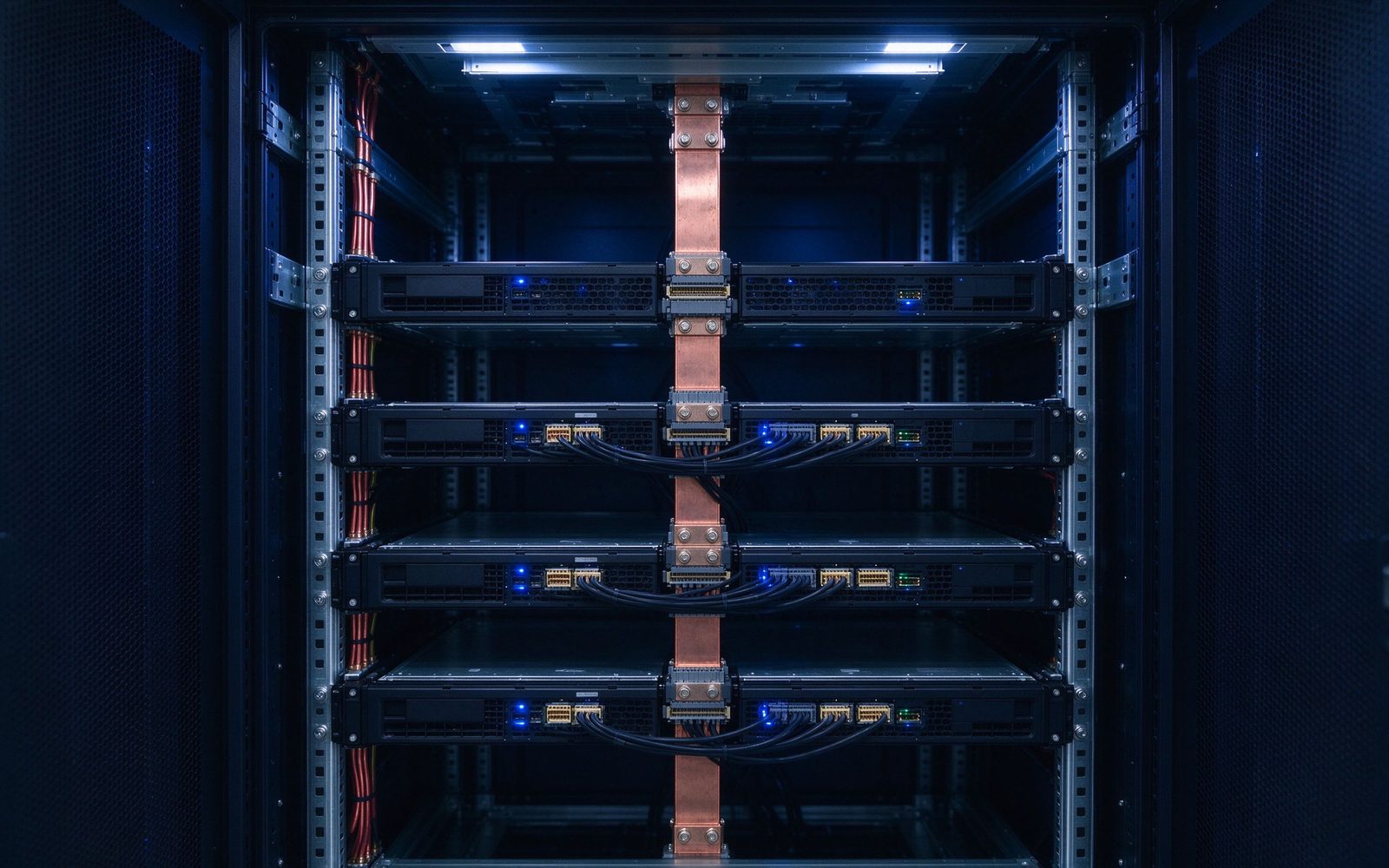
During FAT the bus runs at full current with thermal imaging: the rise lands inside the 30 K budget, the sharing between the two rectifier sections reads within 3%, and the double-pulse-equivalent transient test confirms the commutation spike stays below the insulation margin. That pattern - document the sharing, prove the rise, verify the transient - is the deliverable an EPC contractor can sign.
An electrolyser plant runs continuously, and the DC bus is the one part of the power system that is never cycled off for maintenance. Long-term reliability therefore comes from design margin plus inspectability: bolted joints with defined torque and spring washers that hold preload through thermal cycling, plating specified for the plant's atmosphere (silver or tin, never bare copper in a hydrogen plant's humid enclosures), and torque values documented on the drawing so inspection intervals are meaningful.
The same discipline applies to the plant's periodic IR surveys: thermographic inspection of busbar joints finds a failing connection before it becomes an unscheduled stop. For the busbar supplier, the design documentation - rise calculation, joint torque, plating spec, sharing analysis - is what turns a component purchase into a reliability program.
Large electrolyser programs buy the DC bus the way they buy the rectifier: against a specification, with a qualification round. The specification typically covers continuous current at the stated rise, voltage class and transient withstand, creepage and clearance, terminal scheme, sharing tolerance between parallel sections, and the inspection evidence set. The qualification round verifies first articles: dimensions, plating, insulation test, temperature rise at full current, and the sharing measurement.
The procurement consequence for a busbar supplier is that the engineering desk is the product. The buyer sends a current profile and an envelope; the supplier returns a sizing calculation, a drawing and a price - and the calculation survives the review meeting. Factory-direct suppliers with documented build practice fit this pattern; catalogue vendors do not. For the surrounding application context, the renewables application page and the custom project page describe the same engagement model.
One further procurement point deserves emphasis: the FAT is witnessed. In electrolyser projects the EPC contractor and often the end customer attend the factory acceptance test, and the busbar is part of the witnessed scope: temperature rise at rated current, insulation test, sharing measurement and visual inspection of plated faces are demonstrated live, and the record is signed. That changes what the supplier must be able to do on the day - not just produce a report, but reproduce the test in front of an audience. The consequence for the engineering process is that the sizing calculation, the drawing and the test plan must be consistent before the FAT date arrives, because the witness will ask why the rise is where it is and why the sharing reads as it does.
The same witnessed-test pattern applies to the dielectric system. A 1,500 V DC bus is insulation-tested at a multiple of the working voltage, and the test record includes the leakage current and the test duration, not just a pass mark. For a plant running hydrogen in the same enclosure family, the creepage and clearance evidence is part of the safety case that the operator's insurer reviews. Suppliers that treat the FAT as a document-signing event rather than a live engineering demonstration misjudge the risk their customer is carrying.
As plants scale past 100 MW, the electrical architecture moves from one rectifier per stack toward multi-stack DC buses: several rectifier sections feeding a common DC bus that distributes to multiple cell stacks, or one rectifier section per stack with shared auxiliary services. Both patterns change the busbar design. A common bus must carry the sum of currents and manage fault coordination between sections; the per-stack bus must isolate faults so one stack's failure does not drag the plant.
The busbar designer's inputs multiply accordingly: fault current and clearing time per section, bus sectionalising, and the sharing analysis across all sections. Laminated construction remains the right answer - it is the only practical geometry that keeps inductance low and sharing symmetric across a multi-section bus - but the design file grows. SHANYUAN supports multi-section programs with the same documented approach: sizing, sharing, FAT evidence and bilingual documentation, one engineering desk throughout.
Send the current profile, voltage class and terminal types — our engineers reply within one business day.