Layer count drives performance, price and lead time at the same time. This selection guide shows purchasing and engineering how to decide between 2-layer, 4-layer and 6+ layer stacks — and what to write on the inquiry so the quote is comparable.
Every extra conductor layer in a laminated busbar buys you one of three things: more current paths, tighter cancellation of loop inductance, or built-in redundancy. It also adds material, lamination time and inspection effort — which is why layer count is a price and lead-time lever, not just an electrical one.
This guide is written for the person who has to put a number on the RFQ: what the layers do electrically, when more layers stop paying for themselves, and how to state the requirement so quotes from different suppliers are comparable.
1–2 layers cover the large majority of industrial busbar work: a single conductor with one return plane, or two parallel planes. This is the default for inverter DC links, battery module interconnects and PDU distribution where loop inductance can be managed by geometry alone. It is also the fastest and cheapest to tool.
4 layers appear when a phase pair and its return must share one stack (positive and negative planes with two dielectric layers between), or when two circuits must ride in the same footprint. Four layers give meaningful inductance reduction over two, at a moderate cost step.
6+ layers are the high-end: multiple isolated circuits in one stack, or redundancy layers that keep the assembly working if one layer is damaged. They are specified in traction converters, aerospace power units and high-availability rack supplies — and they carry a real price and inspection premium, because every internal interface has to be PD-clean and void-free.
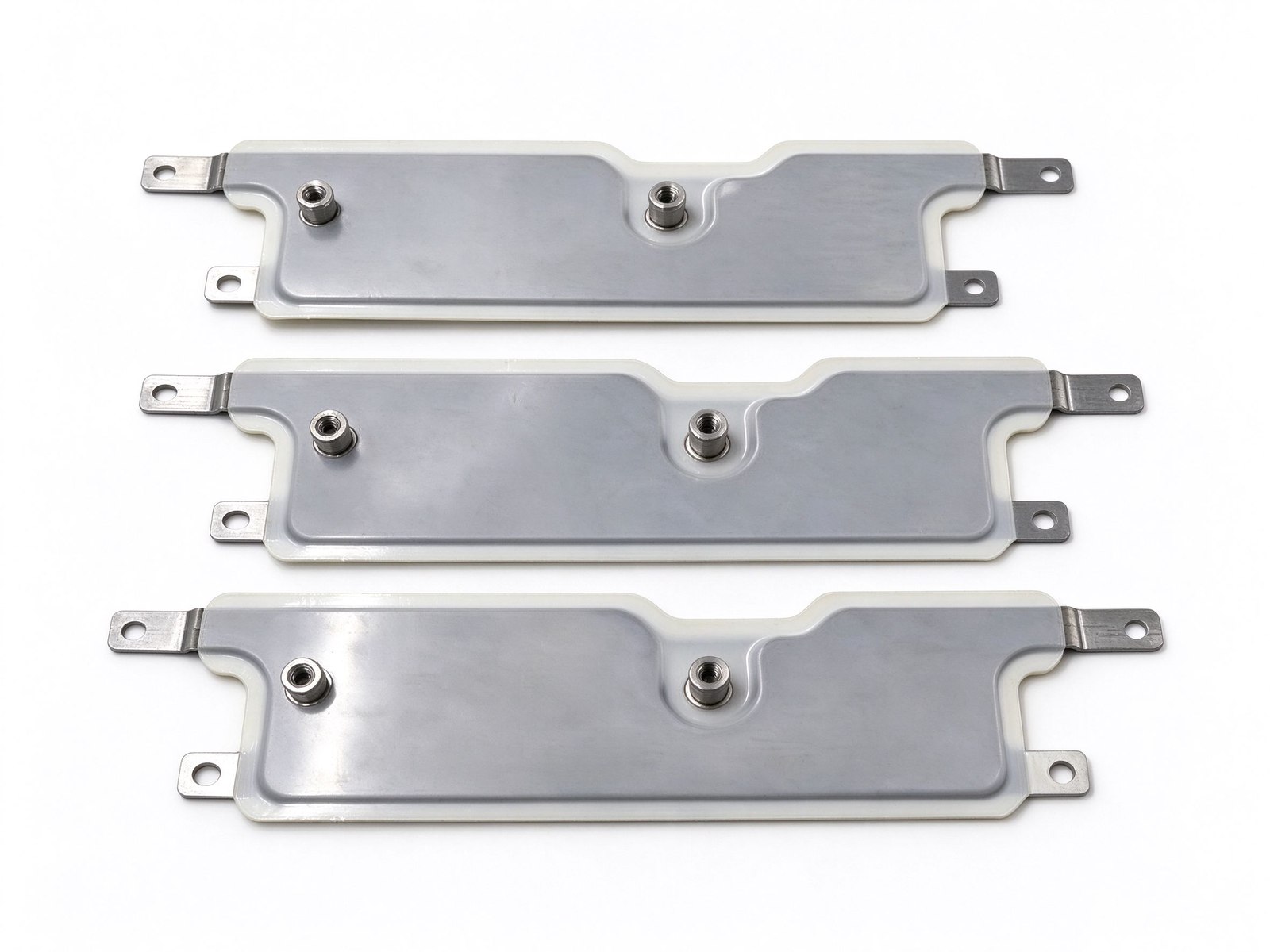
The first gate is thermal. SHANYUAN sizes every stack against a 30 °C rise at rated continuous current, so the question is not “how many amperes” but “how many amperes at what rise, in what ambient”. If one copper layer of a given cross-section can carry the current at 30 °C rise, a second layer is not a current decision — it is an inductance or redundancy decision. If one layer cannot carry it without exceeding the rise, you either grow the cross-section or split the current across parallel layers.
Do not add layers as a substitute for sizing. A wider single layer is usually cheaper than a second thin layer carrying the same current — the lamination cost is per interface, not per gram of copper.
The classic reason to add layers is the commutation loop. In a switching circuit, the loop inductance between the DC-link busbar and the IGBT or SiC module sets the voltage overshoot at turn-off — the number that forces derating or snubbers. Opposing parallel planes spaced close together cancel that loop: two planes already do most of the work, and the gain from four planes over two is real but diminishing.
Our low-inductance design guide covers the layout rules; the procurement takeaway is to state the target loop inductance or the switching frequency and current slew rate in the inquiry, and let the stack design meet it — not to specify “as many layers as possible”, which is how you overpay.

Six and more layers exist mainly for two jobs: multiple isolated circuits sharing one footprint, and redundancy. In a traction converter, positive and negative rails plus auxiliary circuits can all live in one 6-layer stack, saving a cabinet bay. In high-availability supplies, a duplicate layer carries the current if the primary path is interrupted.
Both options have a hidden cost: more layers mean more dielectric interfaces to keep void-free, a longer lamination cycle, and tighter PD acceptance. For most industrial applications the redundancy is better bought at the system level (n+1 modules, see our busbar power distribution guide) than inside one stack.
When you compare quotes, layer count is not the only driver — but it is the most visible one. Each dielectric interface adds material and one extra lamination pass, and every internal layer has to pass visual and electrical inspection before the stack is sealed. A 4-layer stack typically costs meaningfully more than a 2-layer one at the same current; a 6-layer stack is a step change again because the process window narrows.
Ask each supplier to quote the same stack with an explicit breakdown: conductor layers, dielectric type and thickness, plating, and edge sealing. A quote that cannot state these separately is hard to compare — treat that as a selection signal in itself.
Layer count is only as good as the evidence behind it. At sample and series acceptance, the stack should carry four verifications: dimensions against drawing (including flatness, because warpage grows with layer count); insulation resistance and hipot at the specified voltage class; partial discharge to the agreed level (SHANYUAN acceptance uses the IEC 60270 10 pC criterion where specified); and current-carrying capability at the rated temperature rise. Loop inductance is usually verified by measurement or by the switching waveform in the real converter rather than by a standalone test — which is why the target should be fixed at the drawing stage, not discovered at first power-up.
Ask which of these records ship with each lot. A supplier that lists them in the quote and attaches them to deliveries is doing the QC the stack needs; one that offers them only on request is transferring the risk to your commissioning team.
Tooling and sampling scale with layer count too. A 2-layer stack moves through DFM, tooling and sampling quickly; a 6-layer stack adds lamination trials and more inspection stages before first article. If your programme has a fixed launch date, agree the layer count early and freeze it — late changes to the stack are the most common cause of schedule slip in custom busbar projects.
Write these six lines and your quotes become comparable: current per phase and rise target; switching frequency and target loop inductance (or “per drawing”); voltage class for dielectric selection; number of isolated circuits; ambient and enclosure temperature; and annual volume with launch date. Then let the supplier propose the stack — a good supplier will challenge an over-specified layer count, because fewer layers are cheaper and usually sufficient.
Our laminated busbar design guide explains the underlying rules, the ampacity chart gives cross-section ratings, and the product range shows the families. Send your six lines through the contact page for a stack proposal within one business day.
Q: Does a 4-layer busbar always beat a 2-layer busbar? A: No. At the same current, four layers buy lower inductance or dual circuits — not more ampacity. If inductance and circuit count do not require them, two layers are cheaper and faster.
Q: How many layers do EV battery packs use? A: Most cell and module interconnects use 1–2 conductor layers; higher layer counts appear on the traction inverter DC link and integrated pack-level stacks where loops and multiple circuits share one part.
Q: What is the maximum layer count SHANYUAN builds? A: Up to 6+ layers depending on the stack, with each internal interface held to the same PD and insulation standard — tell us the voltage class and we confirm the buildable stack with the quote.
Send the current profile, voltage class and installation conditions — we will size the busbar and document the calculation with your quotation.
Send the current profile, voltage class and installation conditions — we will size the busbar and document the calculation.