On 20 July 2026 the European Commission's Digital Product Passport (DPP) Registry became operational, and from 18 February 2027 every EV battery, every light-means-of-transport (LMT) battery and every industrial battery above 2 kWh placed on the EU market must carry a battery passport under Regulation (EU) 2023/1542. The regulation's supply-chain due-diligence obligations for cobalt, natural graphite, lithium and nickel already apply since 18 August 2025. Busbars are the connective tissue of every one of those batteries — and while the passport obligation sits with the economic operator placing the finished battery on the market, the documentation chain runs all the way down to the conductor metal.
On 20 July 2026 the European Commission's Digital Product Passport (DPP) Registry became operational, and from 18 February 2027 every EV battery, every light-means-of-transport (LMT) battery and every industrial battery above 2 kWh placed on the EU market must carry a battery passport under Regulation (EU) 2023/1542. The regulation's supply-chain due-diligence obligations for cobalt, natural graphite, lithium and nickel already apply since 18 August 2025. Busbars are the connective tissue of every one of those batteries — and while the passport obligation sits with the economic operator placing the finished battery on the market, the documentation chain runs all the way down to the conductor metal.
Regulation (EU) 2023/1542 on batteries and waste batteries is the EU's comprehensive battery law. It covers carbon footprint, recycled content, performance and durability, supply-chain due diligence, labelling, and the digital battery passport. It applies to EV batteries, LMT batteries (e-bikes, scooters), industrial batteries above 2 kWh (including stationary storage, forklifts, grid batteries), and portable batteries for their relevant provisions.
For component suppliers the scope is indirect but real: the batteries we supply busbars into are the regulated products, and the data the economic operator must assemble — material composition, sourcing, recycling design — originates in the component chain, including the copper, aluminum, insulation and plating of every busbar.
The milestones are now concrete. The DPP Registry became operational on 20 July 2026, with a helpdesk and a testing environment live. In July 2026 the Commission adopted the implementing act for the Registry and the implementing decision on six of the eight harmonised standards developed by CEN-CENLEC JTC24. An updated guidance document published on 21 August 2026 consolidates 71 data points for EV, LMT and industrial batteries, marking each as mandatory, optional, conditionally applicable, or not yet due.
The hard date is 18 February 2027: from then, each EV battery, each LMT battery, and each industrial battery with capacity greater than 2 kWh placed on the market or put into service must have a battery passport linked through a QR code. Carbon footprint, recycled content and due-diligence information will not yet be required in the passport from day one — those obligations have their own later application dates — but the passport framework is where that data will land.
The due-diligence chapter is the part already biting today. Article 48(1) of the regulation requires economic operators placing batteries on the EU market to implement a due-diligence policy for cobalt, natural graphite, lithium and nickel — the critical raw materials — from 18 August 2025. Article 52 governs disclosure and publication of the policy, verification report and audit findings. Operators below a €40 million net turnover threshold are exempt unless their group exceeds it on a consolidated basis.
Why this matters for busbars: nickel is a constituent of many battery busbar platings and of the nickel-rich cathode chain; copper, while not on the Article 48 list, is central to battery conductors and increasingly subject to recycled-content scrutiny. A pack maker's due-diligence file will need its suppliers to confirm the provenance and responsible sourcing of the metals in the components they buy — which means the busbar supplier's material certificates and sourcing statements become part of the customer's compliance evidence.
The regulation is explicit that the obligation to create and maintain the battery passport lies with the economic operator placing the finished battery on the market — not with suppliers of individual components or modules. A busbar manufacturer is therefore not directly passport-obligated. But the same regulation makes the economic operator responsible for the accuracy of the data in the passport, and that data includes information the busbar supplier holds: conductor material and mass, plating type and thickness, insulation materials, and in future the recycled content of those materials.
For the busbar supplier the consequence is a documentation duty, not a registration duty: certificates of analysis, material declarations, mass and composition data per part number, and sourcing statements for the metals used. These are standard industrial documents; the new requirement is that they be structured, current and traceable to the specific busbar part in the specific battery.
The Commission's guidance consolidates 71 data points across the three battery categories. The ones that reach into the component chain are the technical and material characteristics: battery identification, chemical composition and mass (where the busbar's copper, plating and insulation are inputs to the cell-to-pack mass balance), manufacturer and economic operator information, and the circularity data — design for disassembly, repairability, and recycling information.
For a busbar, 'design for disassembly' translates into how the busbar is attached: welded joints versus bolted connections, and how a battery pack can be separated into cell, module and component streams at end of life. Welded busbars deliver lowest electrical resistance in service, but bolted or ultrasonic-welded joints are friendlier to repair and recycling — a tension that battery designers now weigh with the passport's circularity requirements in mind. Our joining technology guide quantifies the trade-offs.
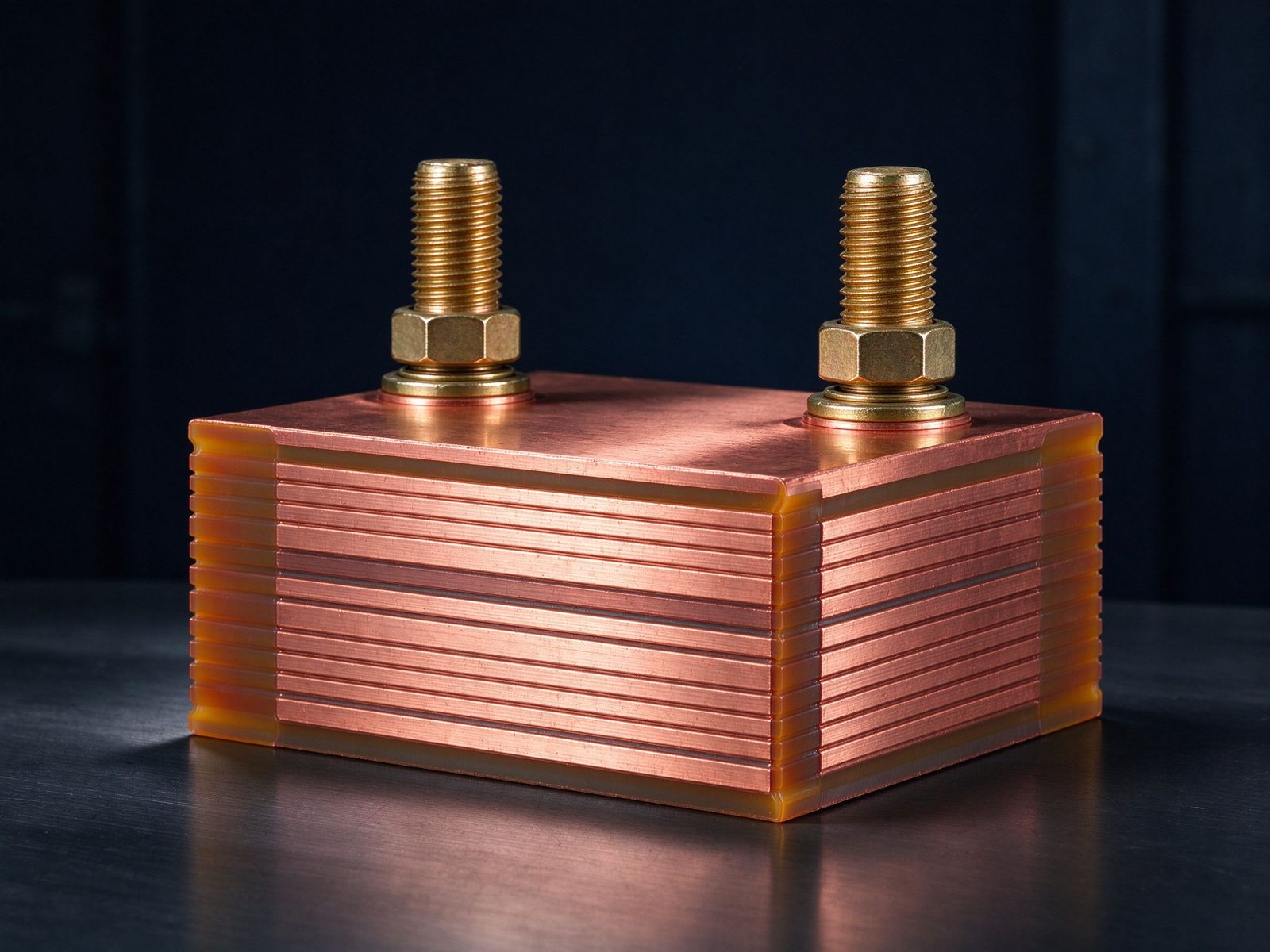
Three material families in a laminated busbar will appear in pack-level declarations: the conductor metal (typically C11000 ETP copper, or aluminum where the pack design allows), the surface treatment (tin, nickel or silver plating, including plating thickness), and the insulation system (PET, Nomex, epoxy DLF or heat-shrink). Each carries compliance relevance: tin plating affects recycling stream classification; nickel plating ties into the nickel due-diligence list; insulation materials affect the polymer content declarations that feed recycling economics.
Suppliers should therefore be ready to provide per-part material declarations with mass breakdown — the same discipline as RoHS and REACH declarations, extended to the new battery-specific fields. For SHANYUAN's battery busbar line, this documentation is part of the standard DFM and quality package, and we extend it with composition data on request.
The recycled-content obligation is the one to prepare for now. Under the regulation, the share of recycled cobalt, lithium, nickel and lead in battery materials will be declared in phases from later application dates, and the passport will carry that information. Recycled-content reporting requires the component chain to track metal provenance: whether the copper in a busbar is primary or contains recycled input, and how that is documented.
Copper's infinite recyclability is an advantage here — recycled copper is indistinguishable in performance — but the accounting trail has to exist. This is why we recommend that battery customers request the recycled-content capability statement from their busbar suppliers now, so the data structure is ready when the reporting dates arrive. The same logic connects to the material substitution debate running in parallel this year.
The carbon-footprint declaration for batteries has its own implementation dates, but the calculation methodology is already active in product environmental footprints (PEF). For a busbar, the footprint inputs are the conductor metal production (copper cathode-to-rod energy, or aluminum smelting energy), the plating process, the lamination and stamping energy, and transport. These are the same figures used in Environmental Product Declarations, which industrial suppliers increasingly provide.
For the busbar supplier the request is predictable: cradle-to-gate carbon data per part, with the methodology disclosed. Having the data model ready — even as an estimate with a clear basis — puts the customer ahead when the mandatory carbon declaration dates arrive, and it is materially easier to build now than to reconstruct later.
Above €40 million turnover the battery due-diligence chapter lands in the same compliance space as the EU Corporate Sustainability Due Diligence Directive (CS3D): supplier auditing, risk management and published verification reports. Busbar suppliers to large pack makers are therefore being drawn into their customers' supplier-engagement programs — questionnaires, audits, and sourcing attestations for the metals in our parts.
The practical posture for a component supplier is proactive documentation: maintain a supplier list with country of origin for conductor metal, hold certificates of analysis for plating baths and insulation materials, and be able to answer an OECD-aligned due-diligence questionnaire without a two-month data archaeology project. This is not speculative — the first requests are already circulating in the 2026 supply chain.
It is worth stating what the regulation does not change. It does not change the electrical engineering of the busbar: current capacity, temperature rise, insulation coordination and terminal design remain governed by the product and safety standards — IEC 60664-1, IEC 61439, UL requirements — which our ampacity guide and insulation coordination notes cover. It does not require the busbar to be passport-labelled itself. And it does not forbid welded joints or specific platings — it asks that the choices be documented and, increasingly, designed for end-of-life.
The regulation adds a documentation and design-for-circularity dimension on top of the engineering. Suppliers who treat it as an engineering-plus-documentation task, rather than a paperwork burden, find it straightforward to support.
If you supply busbars or other components into EU-bound batteries, the working checklist for 2026 is: (1) confirm whether you are an economic operator or a component supplier — you are almost certainly the latter; (2) assemble per-part material declarations with mass breakdown for conductor, plating and insulation; (3) prepare metal provenance and sourcing statements, including recycled content if available; (4) make carbon-footprint data available at PEF/EPD quality; (5) respond to customer due-diligence questionnaires with the OECD-aligned structure; and (6) flag design-for-disassembly choices — bolted versus welded joints — in your DFM dialogue.
None of these are new manufacturing steps; they are new documentation steps, and they are exactly the kind of disciplined data that our quality system already maintains for every part that leaves the plant.
SHANYUAN's quality and engineering documentation is structured for this chain. For every battery busbar part we provide: material certificates for C11000 copper and electrical-grade aluminum; plating type and thickness specifications (tin, nickel, silver); insulation material data (PET, Nomex, DLF epoxy); dimensional and electrical test reports; and traceable lot records from incoming metal to finished assembly. Our factory in Rizhao, China — 17,200 m², exporting to 20+ countries — operates an ISO-structured quality system with full part traceability, which is the practical foundation for the customer's passport data.
Where a customer needs composition data, recycled-content statements or carbon inputs, we supply them with the basis disclosed rather than as unsupported numbers. That is the difference between a supplier that feeds the compliance chain and one that blocks it.
The passport's circularity data points push 'design for disassembly' from a preference into a documented requirement. For busbar design this creates two live tensions. The first is joining: welded joints give the best electrical and thermal performance and are standard in high-current packs, but they complicate cell and module separation at end of life. Ultrasonic welding offers a middle ground — solid-state, low heat, and in many designs releasable with the right tooling. The second is material separation: a busbar bonded to insulation must be separable from the polymer stream for the metals to be recycled cleanly, which favours mechanically separable insulation over permanently bonded systems where recycling is a priority.
These choices are now documentation items in the passport chain, and they are engineering decisions we routinely review in the custom design process alongside electrical performance.
The near-term calendar for the regulation is: October–November 2026, the implementing act defining access to restricted data is expected in draft for public feedback; Q4 2026, sector-specific DPP requirements for iron and steel and the implementing act for battery access rights; early 2027, guidance and registry testing wrap up; 18 February 2027, the passport becomes mandatory for EV, LMT and industrial batteries above 2 kWh. Later application dates bring the carbon footprint, recycled content and due-diligence data into the passport fields.
For suppliers, the 2026–Q1 2027 window is the qualification window: registry onboarding for customers, data structures agreed, and component documentation aligned with the 71 data points. Waiting until December 2026 is how programs slip.
The EU Battery Regulation is the first fully digital product-passport regime, and batteries — with the busbars inside them — are its first product group. The obligation sits with the battery's economic operator, but the data it needs flows from the component chain. For busbar suppliers the message is straightforward: keep the material, provenance and circularity documentation current, make design-for-disassembly part of the DFM dialogue, and treat the compliance chain as an engineering discipline rather than a paperwork burden.
If your EU-bound battery program needs busbar documentation, material declarations or a design-for-recycling review, our compliance and engineering teams will help — and the electrical engineering behind it is unchanged: the same battery busbar capability, now with the paper trail the passport demands.
Record copper prices, a 4.41 copper-to-aluminum price ratio and a structural supply gap fo
Read article
A busbar's reliability is decided in the first 2 mm of the drawing: hole position, bend an
Read article
AI racks move from 140 kW to 1 MW by 2027, and the industry answers with 800 VDC distribut
Read articleSend the current profile, voltage class and terminal types — our engineers reply within one business day.
Send drawings, current ratings and voltage class — DFM feedback and a quotation within one business day.